9 Best Disposable Meal Prep Containers (November 2026)
The best disposable meal prep containers include the PROMOZE 50-Pack Reusable Meal Prep Containers Microwave for all-in-one reheating, the Dealusy 50 Pack for large 32 oz portions, and the Freshware Meal Prep Containers [50 Pack] for portion control.
On this page (8 sections)
- Best disposable meal prep containers for different needs
- How to use the comparison table for disposable meal prep containers
- What size disposable meal prep container should you buy?
- Are disposable meal prep containers microwave and freezer safe?
- How do lids and stacking affect everyday use?
- Plastic or paper: which disposable container is better?
- Should you use smart fridge storage with meal prep containers?
- Verdict: best disposable meal prep containers for most buyers
The best disposable meal prep containers for most people are the PROMOZE 50-Pack 28 oz, because you can pack a full meal, freeze it, carry it and reheat it in the same container. Our score weighs specs, features and buyer feedback against what you are shopping for.
Disposable does not have to mean single use here. Many of these plastic containers are reusable and dishwasher safe, while the paper options suit events and takeout where washing is not practical.
Start with a kitchen food storage container guide if you want broader context on shapes and materials. For reusable options beyond disposable formats, compare our best meal prep containers roundup.
Our picks at a glance
-
1
 Best for all-in-one reheating
PROMOZE 50-Pack Reusable Meal Prep Containers Microwave
9.7/10 our score
See it on Amazon -
2
-
3

- 4
 Best for everyday 24 oz mealsCheck it
- 5
 Check it
50 Disposable Meal Prep Containers 29oz Kraft
Best paper option with forks - 6
 Best extra-thick 32 oz pickCheck it
- 7
 Check it
Celel 35 oz Disposable Meal Prep Containers
Best large paper container - 8
 Best for separate sidesCheck it
- 9
 Check it
Glotoch Express Meal Prep Containers 24oz-100 Pack
Best bulk 100-pack value
Best disposable meal prep containers for different needs
The best disposable meal prep containers depend on capacity, material and how often you plan to reuse them. Plastic wins for washing and stacking, paper wins for one-time serving, and compartment count decides whether sides stay separate.
How we compared these containers
We compared capacity, compartment count, temperature range, lid design and material. We also checked dishwasher use, because a container you can wash and reuse often costs less per meal than a true single-use option.
We checked each maker's stated microwave and freezer limits. Those limits matter more than a general disposable label when you plan to reheat soup, freeze sauce or carry food to work.
Our score weighs specs, features and buyer feedback against what you are shopping for. Higher scores reflect a stronger match for capacity, safety ratings and everyday meal prep use.
We also looked at footprint and height, as a container that is safe and leakproof still needs to fit on a fridge shelf or in a lunch bag. Dimensions in the data help explain why two containers with similar capacity can stack very differently at home.
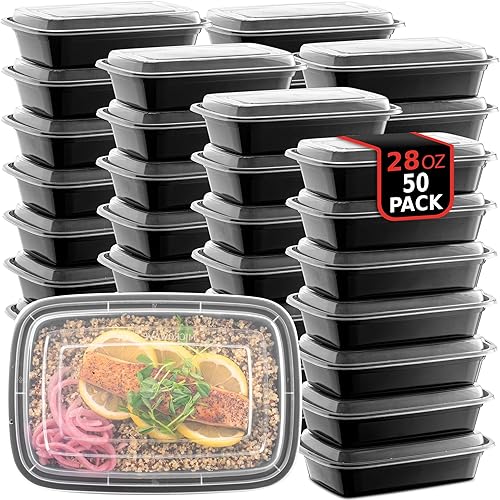
PROMOZE 50-Pack Reusable Meal Prep Containers Microwave: Best for all-in-one reheating
- 50-pack, 28 oz, 1 compartment
- Microwave, freezer and dishwasher safe
- BPA free plastic
- Leak proof lids
A 28 oz single-compartment plastic container you can fill, freeze, carry and reheat without transferring food.
Pros
- Microwave, freezer and dishwasher safe
- Leak proof lids
- Reusable and recyclable
Cons
- Single compartment only
- 28 oz may be large for snacks
PROMOZE suits people who want one container for packing, freezing, carrying and reheating. The 28 oz single compartment fits a full meal without needing a second smaller container for sides.
The plastic is BPA free and rated for microwave, freezer and dishwasher use. A leak proof lid helps when the container travels in a bag or sits in a freezer beside other foods.
At 8.75 by 6 by 1.75 inches, the rectangular shape stacks in a fridge and fits many lunch bags. That size is a practical middle ground between the smaller 16 oz Freshware and the larger 32 oz options.
The hard plastic construction is meant to resist cracks and breaking during transport. The maker also describes freezer use as helping retain flavor, color and texture while limiting freezer burn and odor absorption.
The trade-off is the single compartment. Sauces and vegetables share space, so pick a two-compartment model if separation matters more than simplicity.
The 28 oz size also leaves less room for snacks if you pack light lunches.
Buy it for all-in-one reheating and a reusable plastic format you can wash on the top rack. Skip it for snacks or small portions where 28 oz feels oversized.
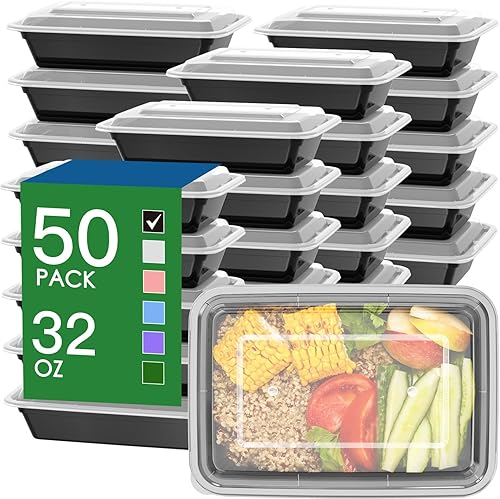
Dealusy 50 Pack: Best for large 32 oz portions
- 50-pack, 32 oz
- Easy open lids
- Microwave and freezer safe
- BPA free
A larger 32 oz rectangular container with tight lids for full meal prep portions.
Pros
- Large 32 oz capacity
- Leakproof and stackable
- Microwave and freezer safe
Cons
- Takes more fridge space than 16 oz or 24 oz options
- Single compartment
Dealusy suits buyers who pack larger meals and want easy open lids. The 32 oz rectangular container gives more room for rice, protein and vegetables in one portion.
It is BPA free plastic rated from -4 F to 248 F for freezer and microwave use. Tight lids are described as leakproof, and the containers stack for fridge storage.
The 50-pack format includes 100 pieces with lids, so you have enough for weekly prep and leftovers. The black rectangular shape also hides food stains better than clear plastic in some cases.
At 8.9 by 6.1 by 2.3 inches, this container is taller and deeper than the 28 oz PROMOZE. That extra depth helps with layered meals but makes small bags and narrow shelves feel tighter.
The trade-off is size. A 32 oz container takes more shelf and bag space than 16 oz or 24 oz options, and the single compartment means foods can mix.
The weight of the full pack also matters if you store many empties together.
Buy it for large portions when a standard lunch container feels too small. Skip it if you pack light snacks or need separate compartments.
Freshware Meal Prep Containers [50 Pack]: Best for portion control
- 50-pack, 16 oz, 1 compartment
- Microwave, dishwasher and freezer safe
- BPA, PVC and phthalate free
- Airtight lids
A smaller 16 oz container that helps keep portions contained for lunches and weight-conscious meal prep.
Pros
- Compact 16 oz size
- Wide temperature range
- Airtight and stackable
Cons
- Too small for some full dinners
- Single compartment
Freshware suits portion control and smaller meals. The 16 oz single compartment helps keep a lunch contained without extra space that invites overfilling.
The container is BPA, PVC and phthalate free, with a stated range from -40 F to 250 F. That range covers freezer storage and microwave reheating for many everyday foods.
Airtight lids help with fridge storage and carrying. The 50-pack gives you enough containers for a weekly prep routine with extras for leftovers.
At 7.7 by 5.5 by 1.4 inches, the shallow rectangular shape is compact for bags and shelves. The maker describes heavy duty construction to resist cracking or melting compared with lighter containers.
The trade-off is capacity. A 16 oz container will be tight for a large dinner, pasta or a meal with a big side portion.
It works best when you measure portions in advance or pack a second container for extras.
Buy it for controlled portions and compact lunches. Skip it for hearty dinners or soup, where a larger container works better.
Dealusy 50 Pack: Best for everyday 24 oz meals
- 50-pack, 24 oz
- Reusable with lids
- Microwave and freezer safe
- BPA free
A mid-size 24 oz square container that balances portion size with fridge and bag space.
Pros
- Practical 24 oz capacity
- Leakproof and stackable
- Dishwasher safe
Cons
- Single compartment
- Less room than 32 oz or 35 oz options
Dealusy suits everyday meals at a middle size. The 24 oz square container fits many single servings without the bulk of a 32 oz or 35 oz container.
It is BPA free plastic rated from -4 F to 248 F for microwave and freezer use. The maker describes the lids as leakproof and the containers as stackable for storage.
At 7.4 by 5 by 2 inches, the square shape can fit fridge shelves and lunch bags efficiently. It also washes by hand or on the top rack of the dishwasher.
The 100-piece count in a 50-pack means lids are included for each container. That format suits a weekly routine where you prep several meals and freeze some for later in the week.
The trade-off is the single compartment and mid-size capacity. It will not separate sides, and it holds less than the 32 oz Dealusy or WGCC options.
Square corners can also make scooping from the corners a little less smooth than a round shape.
Buy it for balanced everyday portions when 16 oz is too small and 32 oz is too large. Skip it if you need compartments or the largest capacity.
50 Disposable Meal Prep Containers 29oz Kraft: Best paper option with forks
- 50-pack, 29 oz kraft paper bowls
- Includes lids and forks
- Microwave and freezer safe
- Water and oil resistant
A 29 oz kraft paper bowl set with lids and forks for takeout, picnics and one-time use.
Pros
- Includes forks
- Water and oil resistant
- Microwave and freezer safe
Cons
- Paper construction, not plastic
- Do not heat the lid
This kraft paper set suits takeout, picnics and events where you want a disposable format with utensils included. The 29 oz bowl holds salads, pasta, snacks and deli foods for one serving.
The package includes 50 bowls, 50 lids and 50 forks. Thickened kraft paper is described as water and oil resistant, with leak resistance for up to 72 hours.
It is listed as microwave and freezer safe for the bowl, while the lid should not be heated. That distinction matters when you reheat food for serving.
The maker describes an anti-pressure construction that supports substantial weight. The lid fit is snug, with guidance to align one corner first and press the other three corners for a secure seal.
The trade-off is material. Paper will not wash and reuse like the plastic options, and heavy or very wet foods need a secure lid fit.
The rectangular kraft color also differs from black plastic, which some buyers prefer for a uniform look.
Buy it for paper-based serving with forks included. Skip it if you want a washable container for repeated freezer meals.
WGCC Meal Prep Containers: Best extra-thick 32 oz pick
- 50-pack, 32 oz
- Extra-thick plastic
- Microwave, dishwasher and freezer safe
- BPA free
An extra-thick 32 oz plastic container with an airtight lid for meal prep, school and office lunches.
Pros
- Extra-thick construction
- Airtight lids
- Wide temperature range
Cons
- Single compartment
- Large footprint for small bags
WGCC suits buyers who want an extra-thick plastic container in a 32 oz size. The single compartment fits diet portions, takeout meals and kid lunches in one container.
It is BPA free and rated from -40 F to 250 F for microwave, dishwasher and freezer use. Airtight lids help keep fridge odors away from food and reduce spills.
At 8.6 by 5.9 by 2.4 inches, the rectangular container stacks in a cupboard or fridge. The thick plastic construction is meant to resist cracks during transport.
The maker describes the lids as helping prevent food from spoiling by keeping air away. That airtight design also helps when containers sit beside strong smelling foods in a shared fridge.
The trade-off is the large footprint and single compartment. Smaller bags and shelves may feel tight, and sides will share space with the main food.
The pack weight in the data is also higher than some rivals, which matters for storage.
Buy it for thick plastic and large portions. Skip it for compact snack packing or compartmented meals.
Celel 35 oz Disposable Meal Prep Containers: Best large paper container
- 50-pack, 35 oz paper containers
- PE-coated kraft paper
- Freezer and microwave safe
- Write-on surface
The largest paper option here at 35 oz, with a write-on surface for labeling frozen meals.
Pros
- Largest capacity here
- Grease resistant
- Easy to label
Cons
- Paper, not plastic
- Deeper 3-inch height takes shelf space
Celel suits people who want the largest paper container here. The 35 oz size holds a full meal, soup or saucy food that would overflow smaller paper bowls.
The PE-coated kraft paper is described as grease resistant and freezer safe without softening. The outer surface is easy to write on, which helps when you label names and dates before freezing.
At 6.85 by 5.1 by 3 inches, the deeper shape offers height for layered foods. The matching lids fit snugly to help prevent spills during transport.
The 50-pack includes 50 bowls and 50 lids in thick cartons. That packaging helps keep the set intact in delivery and saves home storage space when the box is opened.
The trade-off is storage space and material. A 3-inch height takes more shelf room than shallower options, and paper cannot be washed for reuse.
Flip top closure also differs from snap lids on the plastic picks, so check your preference for takeout use.
Buy it for large paper meals and labeling. Skip it if you prefer shallow plastic containers or need dishwasher-safe reuse.
Glotoch 50 Pack: Best for separate sides
- 50-pack, 32 oz, 2 compartments
- Leak proof airtight lids
- Microwave and freezer safe
- BPA free
A 32 oz two-compartment container that keeps a main course separate from sides.
Pros
- Two compartments
- Airtight lids
- Reusable and stackable
Cons
- Less room per item than a single compartment
- Microwave use should remove lids
Glotoch suits meals where sides should stay separate. The 32 oz container has two compartments, so a main course and an entree or side do not mix in transit.
The lids are described as airtight and leak proof. The plastic is BPA free and rated from -40 F to 270 F, with microwave, freezer and top-rack dishwasher use.
At 8.4 by 6 by 1.77 inches, the rectangular container stacks for storage. The 50-pack includes 50 containers and 50 lids for weekly prep or takeout use.
The maker describes high tolerance for bending, twisting and temperature. That flexibility is meant to reduce cracking compared with thinner disposable containers that can fail during carrying.
The trade-off is compartment size. Each side has less room than a full single-compartment 32 oz container, and lids should be removed for microwaving.
It is less suited to soup or a large mixed pasta portion that needs one open space.
Buy it for separated mains and sides. Skip it if you want one large space for soup, pasta or mixed dishes.
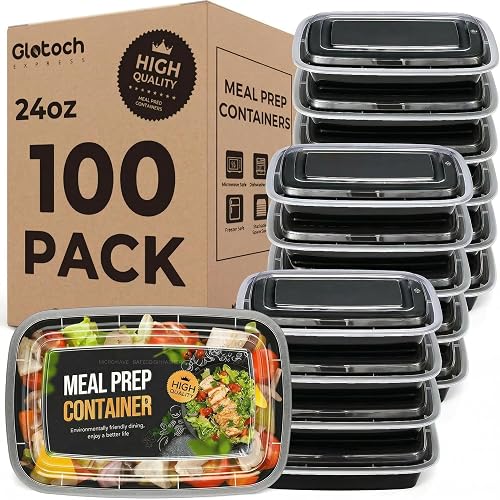
Glotoch Express Meal Prep Containers 24oz-100 Pack: Best bulk 100-pack value
- 100-pack, 24 oz, 1 compartment
- Microwave, freezer and dishwasher safe
- Leakproof lids
- BPA free
A 100-pack of 24 oz plastic containers for high-volume meal prep, catering and shared kitchens.
Pros
- Largest pack count
- Leakproof and stackable
- Microwave, freezer and dishwasher safe
Cons
- Large storage footprint for the box
- Single compartment
Glotoch Express suits high-volume prep and shared kitchens. The 100-pack of 24 oz containers gives you a large supply for meal prep, catering and holiday leftovers.
The single compartment fits pasta, salad, sandwiches and Chinese food in a standardized portion. The plastic is BPA free and rated from -4 F to 248 F.
It is microwave, freezer and dishwasher safe, with leakproof lids and a stackable design. The maker notes the material may feel softer while resisting cracks during heating or freezing.
The maker explains the softer feel as an optimization for durability and crack resistance. That trade-off in hand feel can be worthwhile if you plan many freeze and reheat cycles.
The trade-off is storage for the box itself. A 100-pack takes more cupboard space than a 50-pack, and the single compartment does not separate foods.
The shape is described as slightly taller than other 24 oz containers, which helps stacking but changes bag fit.
Buy it for bulk use when you prep often or pack for several people. Skip it if you have limited storage or need compartments.
How to use the comparison table for disposable meal prep containers
Use the comparison to match capacity first, then material, then compartment count. Capacity decides whether a meal fits, material decides reuse, and compartments decide whether foods stay separate.
| Product | Best for | Capacity | Count | Compartments | Our score |
|---|---|---|---|---|---|
| PROMOZE 50-Pack Reusable Meal Prep Containers Microwave | all-in-one reheating | 28 oz | 50 | 1 | 9.7 |
| Dealusy 50 Pack | large 32 oz portions | 32 oz | 50 | 9.5 | |
| Freshware Meal Prep Containers [50 Pack] | portion control | 16 oz | 50 | 1 | 9.4 |
| Dealusy 50 Pack | everyday 24 oz meals | 24 oz | 50 | 9.3 | |
| 50 Disposable Meal Prep Containers 29oz Kraft | paper option with forks | 29 oz | 50 | 9.1 | |
| WGCC Meal Prep Containers | extra-thick 32 oz pick | 32 oz | 50 | 1 | 8.9 |
| Celel 35 oz Disposable Meal Prep Containers | large paper container | 35 oz | 50 | 8.6 | |
| Glotoch 50 Pack | separate sides | 32 oz | 50 | 2 | 8.4 |
| Glotoch Express Meal Prep Containers 24oz-100 Pack | bulk 100-pack value | 24 oz | 100 | 1 | 8.2 |
For soup and liquid-heavy meals, read our best meal prep containers for soup guide before choosing a shallow container. Deep paper and plastic options here hold liquid better than a snack-size container.
If you prefer glass for reheating and storage, compare our best meal prep containers glass guide. Glass suits long-term reuse, while disposable plastic and paper suit transport and one-time use.
For fridge organization, our best stackable meal prep containers guide explains how stacking affects shelf space. Stackable lids matter as much as container shape when you prep several meals.
How to read capacity, material and compartments together
A large capacity does not help if the material cannot be washed for your routine, and a good material does not help if compartments mix foods you want separate. Treat the three filters as a sequence rather than a single score.
Start with the meal you pack most often, then decide if you will wash the container or discard it. That order prevents buying a 35 oz paper container for a routine that needs daily dishwasher reuse, or a small plastic container for a large dinner.
What size disposable meal prep container should you buy?
Buy 16 oz for snacks and controlled portions, 24 oz to 28 oz for most single meals, and 32 oz to 35 oz for large dinners and leftovers. Size is the first filter because it affects bag fit, fridge space and how much food you pack.
When 16 oz is enough
Choose 16 oz when you pack a light lunch, a snack or a portion-controlled meal. The Freshware 16 oz container makes it easier to stop at a set portion.
A shallow 1.4 inch height also helps when you use a slim lunch bag or a crowded fridge shelf. That compact footprint is a practical advantage if you carry food on public transport.
When 24 oz to 28 oz is the sweet spot
Choose 24 oz to 28 oz for everyday meal prep with a main and a moderate side in one compartment. The PROMOZE 28 oz and Dealusy 24 oz fit this range well.
This range often avoids a second container for leftovers while still fitting many standard lunch bags. It is a good middle ground if you are unsure between snack and large dinner sizes.
When 32 oz to 35 oz makes sense
Choose 32 oz to 35 oz for large appetites, leftovers and saucy foods. The Dealusy 32 oz, WGCC 32 oz and Celel 35 oz suit bigger portions.
Deeper height in this range helps with layered foods and liquids, but it also raises the stack height in the fridge. Measure your shelf clearance before buying a large pack.
Are disposable meal prep containers microwave and freezer safe?
Most picks here are microwave and freezer safe, but lid rules and temperature limits differ by model. Check the range for each container before reheating or freezing, and remove lids when the maker advises it.
Plastic options here list ranges such as -4 F to 248 F or -40 F to 250 F. Paper options list microwave and freezer use for the container, with a warning not to heat some lids.
For the bowl in the kraft paper set, do not heat the lid. For the Glotoch two-compartment model, microwave use should remove lids.
Those details change how you reheat at work or school.
Freezer safety also depends on headspace. Leave room for soup and sauces to expand, and label containers so older meals get used first.
Lid rules that change reheating
Some containers can be microwaved with the lid on, while others need the lid removed or vented. Check the maker guidance for the exact model instead of assuming a rule from another container in this list.
Paper bowls add another limit, as the bowl may be microwave safe while the lid is not. That split matters when you want to reheat and serve without transferring food to a plate.
How do lids and stacking affect everyday use?
Airtight, leakproof lids matter more than container color or shape when food travels to work or school. A good lid keeps soup in the container and fridge odors out of your meal.
Snap lids on the PROMOZE, Dealusy, Freshware and WGCC options help with daily carrying. Flip top lids on the Celel paper containers offer another closure style for takeout use.
Stacking saves fridge space when you prep several meals at once. Rectangular and square containers stack more predictably than round bowls in a standard shelf.
Use Using Specialized Storage Zones for Better Food Safety to place raw and cooked foods safely in your fridge. A container with a tight lid helps, but shelf placement still matters.
Planning stacks before you prep a week of meals
Stack depth depends on height, lid shape and whether containers nest or sit flat. A few extra millimeters per container can turn a tidy stack into a shelf that blocks colder air.
Test one stack in your fridge before filling every container for the week. If the stack is unstable, separate meals across shelves rather than forcing a tall tower.
Plastic or paper: which disposable container is better?
Plastic is better for washing and repeated freezer use, while paper is better for one-time serving and built-in utensils. Choose by whether you plan to wash the container after use.
Plastic options from PROMOZE, Dealusy, Freshware, WGCC and Glotoch are reusable and dishwasher safe. That makes them practical for weekly meal prep where you wash and refill containers.
Paper options from the kraft set and Celel suit picnics, parties and takeout where washing is not expected. The kraft set includes forks, and Celel offers a write-on surface for labels.
Paper also needs closer attention with very wet or oily foods. The kraft paper set is described as water and oil resistant, while Celel uses PE-coated kraft paper for grease resistance.
When paper still suits meal prep at home
Paper can suit home prep when you freeze meals for others, pack food to give away, or want a container you do not need to retrieve and wash. The write-on surface on Celel helps with names and dates in shared freezers.
Paper is less suited to a daily wash and reuse loop, as the coating and structure are not designed for repeated dishwasher cycles. Choose plastic if reuse is the main reason you buy a large pack.
Should you use smart fridge storage with meal prep containers?
Smart fridge zones can help you organize prepped meals, but container safety ratings still decide microwave and freezer use. Zones help with temperature placement, while lids and materials handle transport and reheating.
Read Smart Fridge Cooling Zones: Customize Your Food Storage if your fridge lets you set different zones for different foods. Use those zones to keep ready-to-eat meals away from raw ingredients.
Label each disposable container with contents and date, even when the material has a write-on surface. A clear label prevents forgotten meals and helps you rotate older containers first.
Zones also help with stacking, as ready-to-eat containers should be placed where they stay cold and are easy to reach. That placement works best when lids are sealed and containers are not overfilled.
Verdict: best disposable meal prep containers for most buyers
Pick the PROMOZE 28 oz for all-in-one reheating, the Dealusy 32 oz for large portions, the Freshware 16 oz for portion control, and the Glotoch two-compartment 32 oz for separated sides. Those four cover most meal prep routines without overbuying capacity.
Pick the kraft paper 29 oz set for events with forks included, and the Celel 35 oz for large paper meals you want to label. Pick the Glotoch Express 100-pack when bulk supply matters more than compact storage.
The best disposable meal prep containers are the ones you will actually reuse, stack and reheat without hassle. Match size to your meals, check the temperature range, and confirm the lid seals well before you commit to a large pack.
Our top 3 picks at a glance
-
1
Best for all-in-one reheating
PROMOZE 50-Pack Reusable Meal Prep Containers Microwave
9.7/10 our score
See it on Amazon -
2
-
3
Frequently asked questions
Are disposable meal prep containers safe for the microwave?
Many plastic and paper options here are listed as microwave safe. Check the temperature range and lid instructions for the exact container before reheating, and vent or remove lids when the maker advises it.
Use containers rated for microwave use rather than assuming every disposable container is suitable.
Can disposable meal prep containers go in the freezer?
Most picks here are listed as freezer safe, including plastic and paper options. Freezer-safe containers help protect texture and reduce freezer burn when lids seal well.
Leave headspace for expansion with soups and sauces, and label each container with contents and date.
How many disposable meal prep containers should I buy?
A 50-pack suits a weekly meal prep routine for one person or a small household. A 100-pack makes more sense for larger families, catering, lunch packing for several people, or frequent portion prep.
Choose count based on how often you wash and reuse containers versus get a fresh one.
What size disposable meal prep container is best?
16 oz works for snacks and controlled portions, 24 oz to 28 oz suits many single meals, and 32 oz to 35 oz fits larger dinners and leftovers. Match size to your typical meal, bag size and fridge shelf height.
Smaller containers stack more easily, while larger ones reduce the need for a second container.
Are plastic or paper disposable containers better?
Plastic suits repeated washing, stacking and long freezer storage for most options here. Paper suits one-time serving, contains forks in some sets, and offers a write-on surface on some models.
Choose by reuse plans, food type and whether you want a container you can wash and keep.