Inline Water Filter: The Complete Buying Guide
An inline water filter sits in a water line to treat water for a fridge, ice maker, faucet or under sink system: choose it by line size, flow rate, target contaminants and replacement cost. This guide links every related water filtration topic so you can compare inline, under sink, countertop and RO options before you buy.
On this page (11 sections)
- What does an inline water filter do in a home water line?
- Which inline water filter fits a refrigerator or ice maker?
- How do you choose an inline water filter for home use?
- What is a reverse osmosis system and when is it better?
- How do you compare under sink, countertop and pitcher filters?
- What size, flow rate and pressure should you check?
- How do housings, cartridges and fittings affect upkeep?
- What certifications, claims and limits should you read?
- How do you install, flush and maintain an inline filter?
- Which products fit each need in this guide?
- How should you decide between inline, under sink and RO?
An inline water filter sits in a water line to treat water for a fridge, ice maker, faucet or under sink system: choose it by line size, flow rate, target contaminants and replacement cost. This guide is the starting point for the full water filtration category, and it links to each topic cluster below.
You will find the core lines, the housing, the cartridge and the faucet boosted side of the system in one place. You can then move to the focused roundups for home, small, fridge and housing uses.
You can also compare pitcher, countertop, under sink and RO paths when an inline unit is not the best fit.
Our score weighs specs, features and buyer feedback against what you are shopping for. Products appear highest score first, and each one below earns its place through a clear spec, a clear fit or a clear trade off.
What does an inline water filter do in a home water line?
An inline water filter treats water as it travels through a line to a tap, fridge dispenser or ice maker.
It is a point of use filter, not a whole house system, so it covers one outlet or one appliance line.
That limit shapes everything else in this guide.
Water for a shower or a laundry line will not pass through this unit.
Water for one fridge dispenser, one ice maker or one drinking faucet will.
So you should judge the filter by the task at that single point.
A fridge line needs steady low flow and a slim body.
A kitchen faucet needs faster flow and enough media to keep taste stable through the day.
Most inline units use a carbon block, carbon granules, a sediment pre layer or a mix of those media.
Carbon helps with chlorine, taste and odor.
A finer pre layer helps with rust, sand and suspended particles.
The exact reduction list depends on the media and the test standard, so read the claim for each model.
Do not treat the word carbon as a full claim on its own.
Two carbon units can differ in particle size, contact time and the contaminants listed for testing.
Check whether the claim covers taste and odor only, or also lead, PFAS, fluoride or other health related items.
Also check whether the claim is for the full system or only for a component.
That detail changes what you can reasonably expect at home.
Flow matters as much as media.
A filter that is too small for the line can slow the dispenser or the faucet.
A filter that is too large can waste space under a sink or behind a fridge.
Line size, outlet size and rated flow should match the job.
A 1/4 inch fridge line and a 3/8 inch under sink line do not ask for the same housing or fitting.
The wrong pairing can add adapters, add joints and add places for leaks.
So measure the existing tubing before you order.
Note whether the line is plastic, copper or a mix of both.
Note the thread on the feed valve as well.
Those notes make the fitting choice much simpler at install.
Pressure also affects daily use.
Low pressure can make even a well sized filter feel slow at a dispenser.
High pressure can stress joints if the unit or fittings are not rated for it.
Check the pressure range for RO systems in particular.
Check the flow rating at a stated pressure for under sink units.
That pairing tells you more than a headline flow number alone.
Cartridge life is the other limit.
It is set by gallons, months or both.
Municipal water with heavy sediment or chlorine can use a cartridge faster than light use water.
A home that fills several kettles a day will use capacity faster than a home that uses the tap for one glass a day.
So the same rating can last a year in one kitchen and far less in another.
Plan for the replacement cartridge from the start.
Keep a spare in a clean, dry place where you can reach it without moving the whole under sink store.
Label the install date on the housing or in a phone note.
That record helps you spot a pattern if flow drops early.
It also helps you decide whether the next cartridge should be the same size or a larger one.
Care is simple but steady.
Flush a new cartridge before first use, as the maker directs.
Check both joints after the first flush and again the next day.
Look for slow drips, damp tubing and white mineral marks at fittings.
Wipe the housing when you change a cartridge and check O rings for damage.
Replace a worn O ring before it becomes a leak.
Store a removed cartridge as directed if you plan to keep it fresh for a short period.
Do not freeze a cartridge unless the maker says to do so.
That storage note appears in the Waterdrop data and it is a useful reminder for other brands to check their own guidance.
In daily use, the best inline filter is the one you notice least.
Flow stays steady, taste stays clean and the change arrives on schedule.
If you have to work to reach the unit, that balance is harder to keep.
So choose access as well as media.
A slim unit behind a fridge may suit taste control but suit access poorly.
A compact under sink unit with a twist change may suit a busy kitchen better.
Match the design to your habits, not only to the spec list.
That is how a small filter in a line can do a steady job for years.
Which inline water filter fits a refrigerator or ice maker?
A fridge inline filter fits when the fridge line needs extra taste and odor control or when the fridge has no built in filter. It can sit behind the fridge, under a cabinet or near the water saddle valve.
Check the line type first. Many fridge lines are 1/4 inch plastic or copper.
The filter needs matching compression or push to connect fittings. A twist fit design can cut install time, but the tube still needs to seat fully to stop leaks.
Check pressure and flow too. A slow fridge dispenser is often a sign of a clogged filter, a kinked line or low pressure.
An inline unit with a fine pore size can help with particles, but it can also slow flow if it loads up fast.
AQUA CREST says its inline unit uses a polyester membrane with a 0.5 micron pore size and coconut shell carbon. It says the unit reduces fluoride, chlorine, taste, odor, rust, suspended solids and colloids, and it says it will not reduce TDS.
That limit matters if you want dissolved solids removed.
If your fridge uses a brand cartridge, start with our best inline water filter for refrigerator roundup. For brand specific cartridges, see the best ge rpwfe filter replacement, best whirlpool gold refrigerator water filter and best waterdrop refrigerator filter guides.
How do you choose an inline water filter for home use?
Choose a home inline filter by outlet, line size and target contaminants before you look at capacity.
A fridge line, a drinking faucet, an RV line and a whole sink line each need a different unit. For RV setups, compare inline water filters for RVs.
Capacity comes later because a large rating cannot fix a wrong fitting or a wrong target.
Start with the outlet.
If the goal is drinking water at a sink, an under sink system or a dedicated faucet gives more room for media than a small inline cartridge.
That extra room can help with flow, contact time and a longer change interval.
If the goal is a fridge or ice maker, a slim inline cartridge behind the unit is often the cleanest fit.
It keeps the fridge door dispenser and the ice maker on the same treated line.
It also avoids a new faucet hole in the counter.
For an RV or boat, check space and fitting type first.
A unit that fits a house cabinet may not fit a narrow bay or a curved line run.
Then check the target list.
Chlorine, taste and odor are common for carbon units.
Lead, PFAS, fluoride, cysts and TDS need specific media or an RO membrane and a clear test claim.
Do not assume every carbon cartridge covers every contaminant.
Carbon can keep essential minerals in the water, so TDS may not fall.
That is normal for many carbon units and it is stated for the Waterdrop models in this guide.
If TDS is your main concern, look at RO rather than a standard carbon cartridge.
Then check fit and service.
Measure the space, note the line size and note whether the cartridge swaps by twist, drop in or wrench.
A filter that is hard to reach will be changed late, and late changes can affect taste and flow.
Leave room to remove the housing or cartridge without cutting the line again.
Check the cold water feed and the outlet direction before you mount anything.
Flush the new unit before drinking and check joints for leaks after pressure returns.
For a broad home shortlist, start with our best inline water filter for home.
For tight spaces, the best small inline water filter roundup shows which units fit narrow cabinets and RV bays.
Use those links after you have fixed the outlet, line size and target list.
That order will keep a shortlist practical and easier to compare.
What is a reverse osmosis system and when is it better?
A reverse osmosis system forces water through a dense membrane to reduce a wide range of dissolved contaminants, including TDS. It is a bigger step than a carbon inline cartridge.
RO systems usually sit under a sink. They need a storage tank or an on demand tank, a drain line and a separate filtered faucet or an air gap faucet.
They produce water more slowly than a carbon unit, and they send a portion of the incoming water to drain during the process.
RO is a good fit when your water report shows high TDS, fluoride, lead, nitrate or PFAS that you want to reduce. It is less of a fit when the only goal is better taste from chlorine.
A carbon unit can handle taste and odor with faster flow and less hardware.
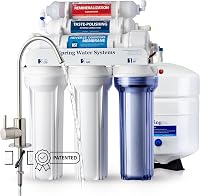
The iSpring system below is a 6 stage RO unit with a 75 gallon per day rating. iSpring says it reduces TDS by 93 to 98 percent and lists reductions for PFAS, chlorine, lead, fluoride, copper, cadmium, chromium, barium, selenium and asbestos. It also has a mineral stage that adds back minerals and raises pH.
If you want the full primer first, read what is reverse osmosis system. For upkeep and spares, see best reverse osmosis system replacement parts.
How do you compare under sink, countertop and pitcher filters?
Compare filter types by speed, capacity and where the water is used. An inline cartridge, an under sink system, a countertop unit and a pitcher each trade convenience for volume and media depth.
An under sink system gives you a full faucet stream with more media and faster flow. It needs cabinet space, a cold water tee and a place for the housing.
It is a strong pick for drinking and cooking water at one sink.
A countertop unit needs no install and moves with you. It fits renters and RV use, but it takes counter space and fills by a reservoir or a faucet diverter.
It is best for one room rather than a busy family kitchen.
A pitcher is the lowest cost start. It needs no tools and no line work.
It filters a batch at a time, so it suits light use, offices and small apartments. It is not a fit when you need high volume or fast flow.
Waterdrop's 10UA is a compact under sink system with a 1 year and 11,000 gallon rating. It uses carbon block and PP folded paper media, has a 0.75 gpm tested flow at 60 psi and a 3/8 inch outlet rated for 1.33 gpm.
Waterdrop says it is for municipal cold water only, not well water or hot water.
For other paths, see best under sink water filter, best nsf certified under sink water filter, best countertop water filter, best water filter pitcher and best nsf 53 water filter pitcher.
What size, flow rate and pressure should you check?
Check line size, flow rate and pressure range as a set. A filter can meet one spec and still fail the job if the other two do not fit.
Line size is the easiest check. Fridge and ice maker lines often use 1/4 inch tubing.
Under sink systems often use 3/8 inch lines with a 1/2 inch converter for the cold feed. An RV or boat line may use a different thread or a quick connect fitting.
Flow rate tells you how fast water can pass. Under sink units are often rated near 0.75 to 2.5 gpm, while fridge inline units are limited by the fridge valve and tubing.
A low flow rating can make a fridge dispenser feel slow even when the water is safe.
Pressure range matters for RO systems and for any unit on a line with a booster or a well pump. The iSpring RO unit lists a 70 psi operating point in its specs and a 284 liters per day maximum flow rate.
Confirm the range for your home before you order.
Space is a spec too. The iSpring unit measures 15.5 by 16 by 18 inches, so it needs a full under sink bay.
The Waterdrop 10UA measures 3.9 by 3.6 by 12.3 inches, so it fits a much narrower cabinet. The AQUA CREST inline unit measures 3.39 by 3.39 by 10.79 inches and weighs 14.4 ounces.
How do housings, cartridges and fittings affect upkeep?
A housing and cartridge system makes upkeep visible and repeatable. The housing holds the cartridge, the O rings seal the joints and the fittings link the unit to the line.
A clear first stage housing helps you see sediment build up. The iSpring RO system uses a transparent first stage housing so you can see when a change is due.
That visual check can prevent a clogged pre filter from slowing the whole system.
Twist and lock cartridges cut change time. Both Waterdrop units below use that design.
The UL12A adds a built in indicator that turns red and beeps when a change is due. That reminder is useful when the unit sits behind stored items under a sink.
Housings come in standard and slim sizes. A standard housing gives more media room.
A slim housing fits tight spaces but may need a more frequent change. Our best inline water filter housing guide compares housing sizes, sump types and head options.
Fittings decide how fast the install goes. Push to connect fittings need no tools for many lines.
Compression fittings need a nut, a sleeve and an insert. The AQUA CREST kit includes 1/4 inch PE tubing, compression and push to connect fittings, a hex nut, a sleeve and an insert.
The brand says to insert the PE tube 20 mm into the cartridge to help stop leaks.
Waterdrop's UL12A is a freestanding under sink unit with no drilling required. It uses a suction cup base for stability and includes a 3/8 inch line plus a 3/8 to 1/2 inch converter.
It is rated for up to 18,750 gallons and 12 months, and it meets NSF/ANSI 42 and 372 standards.
What certifications, claims and limits should you read?
Read certifications as scope, not as a blanket promise. A standard covers specific contaminants, specific test conditions and a specific model.
The scope tells you what the claim means.
NSF/ANSI 42 covers aesthetic effects such as chlorine, taste and odor. NSF/ANSI 53 covers health related contaminants such as lead, cysts, VOCs and some chemicals.
NSF/ANSI 58 covers RO systems. NSF/ANSI/CAN 372 covers lead content in materials.
Each standard is different, so match the standard to your goal.
The iSpring RCC7AK-BN is certified to NSF/ANSI 58 for the full RO system. That is a stronger scope than a component claim.
The Waterdrop 10UA is NSF/ANSI 42 certified and also lists NSF/ANSI/CAN 372. The UL12A meets NSF/ANSI 42 and 372.
The AQUA CREST unit was tested by a third party lab against an NSF/ANSI standard, and its materials are NSF/ANSI approved components.
Limits matter as much as claims. Carbon units keep essential minerals such as calcium, potassium, sodium and magnesium, so TDS may not drop.
Waterdrop says that directly for both of its units. AQUA CREST says its unit will not reduce TDS.
RO units do reduce TDS, and the iSpring unit adds minerals back through its AK stage.
Match the filter to your water source. Waterdrop says the 10UA is for municipal tap water and cold water only.
It says it is not for well water or hot water. If you use well water, get a test first and choose a system built for that source.
How do you install, flush and maintain an inline filter?
Install an inline filter by shutting off the feed, cutting or connecting the line, flushing the cartridge and checking for leaks. The exact steps vary by type, but the order stays the same.
For a fridge inline unit, shut off the saddle valve, release pressure at the dispenser and cut the line only if the fittings need it. Push or compress the tubing into the filter, flush a set amount of water through the unit and check both ends for drips.
For an under sink unit, tee into the cold feed, mount or set the housing, connect the inlet and outlet in the right direction and flush before you drink the water. Keep the housing upright, leave room to drop the sump and keep the cartridge in reach.
For an RO system, plan for the tank, the drain saddle and the faucet hole. The iSpring unit uses a top mounted faucet fastener so you can tighten it from above the counter.
It includes the RO system, a brushed nickel faucet, a storage tank and an extra tool set. It also has a convertible adapter for 1/2 inch NPT and 3/8 inch compression fittings.
Maintain the system on a schedule. Change sediment stages first, change carbon stages on time and change the RO membrane on its own interval.
Store a spare cartridge where you can reach it. Waterdrop says to store a removed filter in a sealed bag in the fridge, not the freezer, to keep it fresh for 30 days.
A fridge line kit with a filter can be a clean way to add taste control without changing the fridge cartridge. See best refrigerator water line filter kit and Best Water Filter For Smart Refrigerators when your fridge has smart features or a built in filter.
Which products fit each need in this guide?
Match each product to the job it does best, not just to the highest score. The four products below cover RO, compact under sink, fridge inline and no drill under sink uses.
The iSpring RCC7AK-BN fits buyers who want RO reduction with mineral add back. It is a 75 GPD system with 6 stages, a transparent first stage housing and NSF/ANSI 58 system certification.
It is the largest unit here, so it needs a full under sink bay and a faucet install.
The Waterdrop 10UA fits buyers who want a compact under sink unit with a simple twist change. It is rated for 11,000 gallons and 1 year, uses carbon block and PP folded paper and has a fast 3/8 inch outlet.
It is for municipal cold water only.
The AQUA CREST INL fits fridge and ice maker lines. It is rated for 5,000 gallons or 5 years, uses a 0.5 micron polyester membrane and coconut shell carbon, and includes both compression and push to connect fittings.
It will not reduce TDS.
The Waterdrop UL12A fits renters and tight cabinets. It needs no drilling, has a suction cup base, a red and beep change reminder and a rating of up to 18,750 gallons or 12 months.
It uses activated carbon and does not reduce TDS.
How should you decide between inline, under sink and RO?
Decide by what you want removed and where you use the water. Inline is best for a fridge or ice maker line.
Under sink is best for fast drinking water at a sink. RO is best for dissolved contaminants and TDS.
Pick an inline unit if the line is 1/4 inch, the space is slim and the goal is taste, odor, chlorine or particles. Pick the AQUA CREST unit for that fridge line job, or browse the best small inline water filter list for other slim options.
Pick an under sink system if you want fast flow at a faucet and more media depth. The 10UA is the compact pick.
The UL12A is the no drill pick with a change reminder. Both keep minerals and do not reduce TDS.
Pick RO if your water test shows dissolved contaminants you want to cut by a high percent. The iSpring unit is the RO pick here, with NSF/ANSI 58 system certification and a mineral stage.
Pair it with the right housing from our best inline water filter housing guide if you need a pre filter or a larger sump.
Pick a pitcher or countertop unit if you rent, travel or want no install. Those paths are covered in the pitcher and countertop guides above.
Pick a fridge cartridge if your fridge already has a built in filter and the manual calls for that exact cartridge.
Start with your outlet, your line size and your water test. Then use the cluster links in this guide to narrow the choice.
That order will keep you from buying a filter that fits the cabinet but not the job.
Frequently asked questions
What is an inline water filter?
An inline water filter sits inside a water line and treats water as it passes through. It is commonly used for a refrigerator, ice maker, drinking water fountain, RV or under sink setup.
The right choice depends on line size, flow, what you want to reduce and how often the cartridge needs changing.
How often should you replace a refrigerator water filter?
Replace a refrigerator water filter on the schedule set for your model and water use, and sooner if flow drops or taste changes. Many built in filters have a set gallon or month limit.
Our guide on How Often Should You Replace a Refrigerator Water Filter? explains the signs to watch.
Does an inline filter remove TDS?
Most carbon inline filters do not remove total dissolved solids. They mainly reduce chlorine, taste, odor and some particles or chemicals, depending on the media.
Reverse osmosis systems reduce TDS.
Check whether a filter uses carbon, sediment media or an RO membrane before you rely on it for dissolved solids.
Can an inline filter feed a refrigerator?
Yes, many inline filters are made for refrigerator and ice maker lines when the fittings and pressure fit. Use 1/4 inch fittings where the line calls for them and flush the cartridge before use.
If your fridge already has a built in filter, confirm whether an extra inline unit is needed.