How to Size a Whole-House Reverse Osmosis System
Size a reverse osmosis system whole house by your peak daily demand first, then by flow rate and pressure. A whole-house unit must keep up during morning showers, laundry and kitchen use at the same time, not just cover total gallons over a day.
On this page (13 sections)
- How much water does your household use each day?
- Why does peak flow matter more than gallons per day?
- How should you check water pressure before you buy?
- What pre-treatment does a whole-house system need?
- How large should the storage tank be?
- When does a whole-house system make sense instead of point-of-use?
- How do refrigerator filters fit into whole-house sizing?
- How does household size change the system you need?
- What space and drainage do you need for installation?
- How much maintenance should you plan for?
- Which sizing mistakes should you avoid?
- How do you pick the right capacity band?
- What is your final sizing checklist for a whole-house system?
Size a reverse osmosis system whole house by peak demand, flow rate and pressure, in that order. Most buyers start with gallons per day and stop there, which is how a system ends up too small at 7 a.m.
A whole-house reverse osmosis system treats water for every tap, shower and appliance. That means it must refill storage while the house is also using water.
Daily capacity alone does not tell you if it can keep up.
If you are not sure what reverse osmosis does, start with what is reverse osmosis system for a plain explanation of the membrane step. Then use this guide to match size to your home.
How much water does your household use each day?
Your daily use is the starting number for sizing. Add up showers, laundry, dishes and toilet flushing before you look at any model.
A simple method works well. Count people in the home, then add guests, pets and extra laundry days.
Homes with more bathrooms, a large garden or a leak-prone fixture can use far more than the head count suggests.
Write down a normal day and a busy day. Size for the busy day if the system feeds showers and laundry, because that is when weak pressure shows up first.
A margin for growth also helps if you plan to add a bathroom or a home office.
Do not use a point-of-use system rating as your whole-house target. A drinking-water unit is built for one faucet and a small storage tank.
A whole-house unit has a different job and a different scale.
Why does peak flow matter more than gallons per day?
Peak flow tells you how fast water is needed at once. A system with enough daily capacity can still fail if its flow rate is too low for two showers running together.
Think about your morning routine. Two showers, a toilet flush, a kettle and a dishwasher can overlap in minutes.
The system and its storage tank must cover that overlap without a long wait for pressure to return.
Flow rate is usually tied to membrane output, pump strength, pipe size and storage volume. A larger membrane can produce more water, but only if pressure and pre-treatment support it.
Bigger is not useful if the rest of the setup cannot feed it.
Ask how the system behaves when storage is low. That moment decides whether showers feel normal or thin.
If you cook with water at the same time, the kitchen demand limits what the bathrooms can get.
How should you check water pressure before you buy?
Pressure decides whether a reverse osmosis membrane can work at full output. Measure your home pressure first, because low pressure can make a large system act like a small one.
You can check pressure with a gauge on an outside hose bib. Check it at rest and while a tap is running, since the second reading shows what the system sees during use.
Note the time of day and whether other fixtures were running.
Low pressure often points to a builder, a pressure regulator setting or a partially closed valve. Those issues should be fixed before you size the membrane, or you may pay for capacity your plumbing cannot use.
High pressure also matters. It can stress seals and fittings and may shorten filter life.
A pressure-limiting step may be needed if your gauge reads high during normal use.
What pre-treatment does a whole-house system need?
Pre-treatment protects the membrane from sediment, chlorine and hardness that can clog or scale it. The filters before the membrane decide how long the membrane lasts in real use.
Sediment can block fine passages. Chlorine can damage some membranes.
Hardness can leave scale that lowers output over time. Your water report and a simple hardness test will tell you which risks matter most in your home.
Whole-house systems often use larger pre-filters than under-sink units because flow is higher. Those filters need space, access and a change schedule.
If you cannot reach them, you will change them late and the membrane will pay for it.
Do not assume one pre-treatment setup fits every street. Well water, city water and a home with old pipes can need different steps.
Let your water test, not a product photo, set the filter list.
How do you match pre-treatment to your water?
Start with sediment and chlorine control for most city supplies. Add hardness control only if your test shows a level that threatens the membrane or your fixtures.
Keep the order simple and readable. Prefilters first, then the membrane, then storage and polishing steps if the design calls for them.
A clear order makes maintenance easier to explain to anyone who services the home later.
How large should the storage tank be?
Storage smooths the gap between production and demand. A larger tank helps during peak use, but it cannot fix a system that produces too little over the day.
Small tanks refill quickly and take less space. They can work for a small home with steady use.
Larger tanks give you more reserve for back-to-back showers, laundry and kitchen work, but they need floor space and support.
Tank size also affects recovery time. After a big draw, the system needs hours to refill at full output.
If your peak hours repeat every morning, recovery time matters as much as the tank label.
Plan the tank location with the unit, not as an afterthought. You need room for the tank, the pre-filters, valves and service access.
A tank wedged against a wall can turn a simple filter change into a hard job.
When does a whole-house system make sense instead of point-of-use?
A whole-house system makes sense when you want treated water at every tap. Choose it for whole-home consistency, not as a bigger version of a kitchen filter.
If your main concern is drinking water taste or specific contaminants at the kitchen sink, a point-of-use unit is often simpler. For a countertop option, compare countertop reverse osmosis systems.
It treats only the water you drink and cook with, and it avoids treating toilets and laundry water.
A whole-house system has higher cost, more waste water and more maintenance. It can also change water chemistry throughout the home, so ask how it affects appliances, fixtures and any existing softener.
Some homes split the job. If domestic sourcing matters, review what to look for in a US-made reverse osmosis system.
They use a whole-house pre-treatment step for the home and a dedicated drinking-water unit at the kitchen.
That split can cost less than full reverse osmosis for every gallon that goes down a toilet.
How do refrigerator filters fit into whole-house sizing?
Refrigerator filters are a separate appliance step. A whole-house system does not remove the need for the filter your refrigerator requires.
Refrigerator filters are shaped for a specific dispenser and ice maker. They use carbon media to handle taste, odor and some contaminants in the water that reaches the fridge.
A whole-house membrane may treat water upstream, but the fridge still needs its own filter for fit and function.
This is also where product type matters. A cassette filter for a side-by-side refrigerator is built for that cabinet, not for whole-house flow.
An inline water filter is a different design again, placed in a line rather than in the refrigerator door.
The Electrolux EWF2CBPA PureAdvantage filter uses carbon filter media and is a single filter in the box. It is certified against NSF/ANSI Standards 42 and 53, including lead, for the claims on its performance data sheet.
That certification detail helps you compare it with other fridge filters, but it does not size a whole-house system.
Choose this type of filter when your refrigerator calls for it. Skip it as a whole-house solution, because its size, flow and fit are built for one refrigerator, not for an entire home.
The everydrop by Whirlpool Ice & Water Refrigerator Filter 1, EDR1RXD1, uses a coconut shell-based carbon core and Triple Filtration Technology. The brand says it is certified to NSF 42, 53 and 401 and to reduce 70 contaminants, including microplastics, under those standards.
It is designed for a precise fit and push-in install in compatible refrigerators. The brand says to replace it every six months or every 200 gallons for crisp water and ice.
That replacement rhythm is a fridge maintenance step, not a whole-house sizing figure.
How does household size change the system you need?
Household size changes demand, but habits change it more. A family of four with two busy mornings can need more flow than a larger home with staggered schedules.
Bathroom count matters because showers create sharp peaks. Laundry matters because a washer draws in cycles that can overlap with dishwashers.
A home office with a long lunch hour can add steady daytime use that a simple head count misses.
We checked the specs on the under-sink examples in this guide to show the gap in scale. They are useful for drinking water, but they are not whole-house units.
That gap is the core sizing lesson.
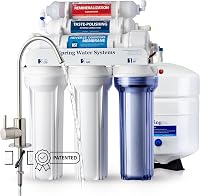
The iSpring RCC7AK-BN is an under-sink system with 75 gallons per day capacity and a 6-stage design. It includes a brushed nickel faucet, storage tank and extra tool set, and it is certified to NSF/ANSI 58 for the full system.
Its output shows why scale matters. A 75 GPD unit is built for drinking water at one sink, with a storage tank to cover draws between production cycles.
A whole-house system must cover many times that demand and must do it through home plumbing.
Use a unit like this for kitchen drinking water if that is your goal. Do not use its gallon rating as a whole-house target, because the flow, storage and plumbing demands are not the same.
How do families of four and six differ in sizing?
Families differ less by head count than by overlap. Two showers at once, plus laundry, is the test that matters for most homes.
If you compare refrigerator size guides while you plan, use them as a reminder that household labels are rough. Our guide to What Is the Best Size Refrigerator for a Family of Four? and our guide to What Is the Best Size Refrigerator for a Family of Six? both show why habits matter more than a fixed number.
For water, list your peak hour in detail. Who showers, who flushes, who runs laundry and who fills a kettle.
That list gives you a flow target you can compare with any system.
What space and drainage do you need for installation?
A whole-house system needs space, drainage and service access. If you cannot drain reject water and reach every filter, the size on paper will not work in your home.
Reject water is the concentrated stream that carries contaminants away from the membrane. It needs a proper drain path that meets local rules.
Some homes use a floor drain, a utility sink or a permitted drain saddle, depending on the setup and local code.
Leave room in front of the unit for filter changes. Pre-filters can be taller than you expect once the housing is open.
Valves, a pressure gauge and a sample port also need space if you want to check performance later.
Check the room for temperature and access. A garage, basement or utility closet can work if it stays within the maker's limits and the lines do not freeze.
A tight corner behind stored boxes is a maintenance problem from day one.
How much maintenance should you plan for?
Maintenance decides whether a whole-house system keeps its rated output. Budget time for pre-filter changes, membrane checks and tank care, not just the install day.
Sediment and carbon pre-filters need changes on a schedule tied to your water and use. The membrane lasts longer, but it is not permanent.
If pre-treatment is late, the membrane can foul and output can drop.
Keep a simple log. Note filter change dates, pressure readings and any change in taste or flow.
That log helps you size the next membrane or spot a problem before showers lose pressure.
Also plan for the person who will service the home if you sell it. Clear labels on valves and a short note on the filter order make handover easier.
A system that only you can understand is a system that will be neglected.
Which sizing mistakes should you avoid?
The most common mistake is buying by daily gallons alone. A reverse osmosis system whole house fails in daily life when flow, pressure or storage is too small for peak hours.
Another mistake is oversizing without pressure. A large membrane fed by low pressure will not produce at its label rate.
You will pay for capacity that stays unused while the tank still runs low in the morning.
A third mistake is skipping the water test. Hardness, sediment and chlorine levels change the pre-treatment list and the membrane life.
A test costs less than a membrane replaced early.
A fourth mistake is treating a fridge filter or an under-sink unit as a whole-house answer. They serve one appliance or one tap.
Whole-house flow needs its own scale, storage and drain plan.
How do you pick the right capacity band?
Pick the capacity band after you list demand, flow, pressure and space. Choose the smallest system that covers your peak hour with margin, then confirm it can recover before the next peak.
Small homes with one bathroom and steady use can start with a lower capacity band and a modest tank. Larger homes with multiple bathrooms, laundry running daily and guests need a higher band and more storage.
Compare systems by the same numbers. Daily capacity, flow at your pressure, tank size, pre-filter size and membrane life should sit side by side in your notes.
If a maker does not state a number you need, ask before you buy.
If you want a point-of-use option for drinking water, our best reverse osmosis system for refrigerator guide covers fridge and kitchen use. For general home use at one tap, see best reverse osmosis system for home.
For smaller spaces, see best reverse osmosis system apartment.
What is your final sizing checklist for a whole-house system?
Use this checklist before you order. A reverse osmosis system whole house is ready to buy only when demand, flow, pressure, storage and drainage all line up.
First, write your normal and busy daily use. Second, write your peak hour and the fixtures that run in it.
Third, record pressure at rest and under flow.
Fourth, list pre-treatment steps from your water test. Fifth, confirm tank size and recovery time.
Sixth, confirm space, drain path and service access.
Seventh, separate fridge and kitchen filters from whole-house sizing. Eighth, plan filter changes and keep a log from the first month.
That order keeps the project honest and makes vendor quotes easier to compare.
Pick the smallest system that covers your peak hour with margin if your home is small and steady. Pick a higher capacity band with more storage if showers, laundry and kitchen use overlap every day.
Skip full whole-house reverse osmosis if your need is drinking water at one tap, and choose a point-of-use system instead.
Frequently asked questions
How do you size a reverse osmosis system for a whole house?
Add up your daily water use, then add a margin for guests, laundry and peak hours. Compare that total with the system capacity, and check flow rate at your home pressure.
A unit that meets the daily total but cannot deliver water fast enough will leave showers weak.
Is a whole-house reverse osmosis system the same as an under-sink system?
No. An under-sink system treats water at one tap and stores a limited amount for drinking.
A whole-house system treats water before it enters your home plumbing, so it needs much higher flow, larger storage and a pump in many homes.
The two solve different jobs.
What pressure does a reverse osmosis system need to work well?
Reverse osmosis needs enough pressure to push water through the membrane. Low pressure slows production and can reduce performance.
We checked the specs on the models in this guide, and you should confirm your home pressure range before you pick a membrane size or pump.
Do I still need a refrigerator filter with a whole-house system?
You may, because refrigerator filters are built for a specific refrigerator and its ice and water dispenser. Whole-house treatment does not replace a filter that the refrigerator maker requires for fit or for its dispenser.
Check your refrigerator model before you skip that step.