What to Look for in a Reverse Osmosis System Made in the USA
A reverse osmosis system made in USA claim is only useful when you can verify where final assembly and key parts were made: look for a named US facility, model-specific country of origin, NSF certification for the full system, and US-based support. If those details are missing, treat the claim as general branding rather than proof of origin.
On this page (12 sections)
- What does made in the USA mean for a reverse osmosis system?
- How do you verify domestic assembly claims?
- Which parts should be made or assembled in the USA?
- What certifications should you check for a US-made RO system?
- How does origin compare with refrigerator water filters?
- How should you check support and replacement parts?
- How does size affect a reverse osmosis system made in USA search?
- How do you compare a US-made claim with fridge RO options?
- What red flags weaken a made in USA claim?
- How should you ask the maker before you buy?
- How do you weigh US origin against performance and price tier?
- Which reverse osmosis system made in USA should you choose?
A reverse osmosis system made in USA is worth checking with care because the phrase can mean different things.
Some brands design a product in the US, assemble it in the US, or only offer support in the US.
Start with the exact model you plan to buy.
Origin claims should apply to that model, not just to the brand in general.
If you want a quick summary of how reverse osmosis works first, read what is reverse osmosis system before you compare origin claims.
This is a single-sentence paragraph.
What does made in the USA mean for a reverse osmosis system?
Made in the USA should mean the system was substantially made in the US, including key parts and final assembly.
Assembled in the USA can mean imported parts were joined here.
Designed in the USA means the engineering happened here, which is different again.
That distinction matters because an RO system is not one part.
It includes a membrane, filter housings, tubing, valves, a storage tank, a faucet, and sometimes a pump or mineral cartridge.
Ask what each major part covers.
A US-assembled unit with an imported membrane and tank is not the same as a unit with US-made housings and US-assembled stages.
Look for plain language.
A maker who says "final assembly in California" is giving you a checkable fact.
A maker who only uses a flag or the word American is not.
A useful check is to list the stages in order and ask for origin stage by stage. That makes vague answers visible quickly.
Rule: accept a made in USA claim only when the maker names the US location and covers the major parts, not just final assembly.
How do you verify domestic assembly claims?
Verify domestic assembly by checking the model label, the manual, and a written statement from the maker.
Do not rely on a marketplace title or a sales page alone.
Search the exact model number with terms like "country of origin," "final assembly," and "manufactured."
Then check the brand's own site, because marketplace copy can be copied across models.
A US phone number or mailing address helps for support, but it does not prove where the unit was built.
Many brands with US offices sell imported systems.
You can also check import records and certification listings for the model.
Those sources will not always list origin, but they can confirm that the model exists and matches the name you are buying.
Keep screenshots or a copy of the answer you receive.
Origin claims can change when a maker switches suppliers or tanks.
Keep the answer tied to the model number, not to a general brand page. That detail is what makes a later parts order match.
Rule: if the maker will not confirm origin for the exact model in writing, shop as if the system was imported.
Where to look first for proof
Check the box label first, then the manual, then the brand site.
Those three places should agree on model name and origin wording.
If the box says one thing and the site says another, ask the maker to clarify.
Do not guess based on the badge on the package.
Compare the capacity and included parts across those sources as well. A mismatch there can signal that a listing covers a different variant.
Which parts should be made or assembled in the USA?
Focus on the membrane, housings, tank, and faucet, because those parts shape performance and service life. Then compare reverse osmosis systems for home.
A US-made faucet does not make the whole system US-made.
The RO membrane is the core stage.
Its origin and certification matter more than the origin of a wrench or a tube clip.
Filter housings and the storage tank affect pressure, leaks, and replacement access.
Note whether they are made in the US or imported.
The faucet and drain saddle are smaller parts, but they affect install quality.
US-made fittings can still be paired with an imported core system.
Ask for a parts breakdown.
A clear answer will name the membrane source, housing source, tank source, and final assembly location.
For a 6-stage system, that breakdown should also cover the mineral stage and each prefilter stage. Each stage your maker lists is a part you can ask about by name.
Rule: judge origin by the core filtration parts first, then by the smaller fittings.
What certifications should you check for a US-made RO system?
Check for NSF/ANSI 58 certification for the full RO system, not just for a single cartridge or stage.
That standard is the one tied to reverse osmosis system performance.
A NSF listing should match the exact model number.
A listing for a different model, a single filter, or a component does not cover the system you will install.
Also check NSF/ANSI 42 and 53 where relevant.
Those cover aesthetic effects and health-related contaminants for many filters, but they do not replace the RO-specific standard.
Certification tells you what was tested.
It does not tell you where the system was made, who assembled it, or how the maker will support it later.
Keep the certificate number and model together.
If a seller cannot share them, treat the certification claim as unconfirmed.
Read the performance data sheet behind the certification, not only the badge. That sheet lists the specific claims the listed model was certified for.
Rule: require a model-specific NSF/ANSI 58 listing for a full RO system before you rely on any performance claim.
How does origin compare with refrigerator water filters?
Refrigerator filters show why origin and certification must be checked model by model.
A filter made for one refrigerator brand is not proof that a full RO system was made in the US.
An inline water filter is a smaller add-on that can fit a line, while a full RO system uses multiple stages under a sink.
Refrigerator filters also rely on exact fit.
That is a useful reminder: the right part for the right model matters more than a general brand story.
The same logic applies to origin.
A US brand name does not turn an imported RO system into a domestic product.
Note the difference in scope when you compare them. A single cartridge certified to NSF 42 and 53 is not the same scope as a full system certified to NSF 58.
Rule: use replacement parts as a clue to model discipline, not as proof of where a full system was made.
When a filter box is the better comparison
Replacement filters show how makers handle fit, life, and certification.
Compare those details across models before you trust a broad made in USA message.
That Electrolux filter uses carbon filter media and is certified by NSF against NSF/ANSI Standards 42 and 53 for the claims on its performance data sheet, including lead.
Its cassette design shows a different kind of control: the maker limits fit to a specific refrigerator family.
That exactness is what you want to see in an RO origin claim too.
The Electrolux EWF2CBPA also shows why fit wording matters. It is described for most Electrolux Icon side-by-side refrigerators, with a slide and click install and a Use and Care Guide check before installation.
How should you check support and replacement parts?
Check whether the maker provides US-based technical support, manuals, videos, and model-specific replacement filters.
Support does not prove origin, but it affects the value of a domestic claim.
A US-made system is easier to keep in service when parts, membranes, and tanks are easy to find.
Ask how long the maker plans to support the model.
Look for lifetime or multi-year support language, but read it closely.
Support may cover advice only, not parts or shipping costs.
Replacement filter sets should be listed by model.
Vague sets that "fit most systems" are a warning sign for a system you plan to keep for years.
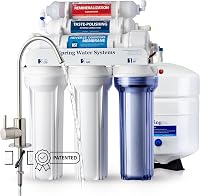
The iSpring RCC7AK-BN has a top-mounted faucet design for countertop install from above.
It includes an RO system, brushed nickel faucet, storage tank, and extra tool set.
Its transparent first-stage housing helps you see sediment buildup.
It is certified to NSF/ANSI 58 for the entire system, which is the detail to verify by model.
Note what this example does and does not prove.
Atlanta support is a service fact.
It is not, by itself, proof that every part was made in the US.
How replacement schedules compare
Replacement timing gives you a practical way to test model discipline. The Electrolux filter typically lasts up to 6 months, and the everydrop filter is listed for replacement every six months or every 200 gallons.
The iSpring system is also listed with a 6-month filter life cycle, with named replacement sets for 6-month, 1-year, 2-year, and 3-year intervals. That named-set approach is easier to verify than a generic promise to supply parts later.
Use those schedules to ask what is included in each set. A set for a 75 GPD system should match that capacity, and a refrigerator filter set should match the exact filter number and color.
How does size affect a reverse osmosis system made in USA search?
Size changes the origin question because larger systems use more imported tanks, pumps, and housings.
A whole-house unit is a different product from a small under-sink unit.
For a whole-home setup, read reverse osmosis system whole house to see how capacity and pressure shape the choice.
A compact apartment unit has fewer parts and may be easier to verify.
That does not make its origin claim automatic, but it makes the parts list shorter.
For small spaces, read best reverse osmosis system apartment to compare compact systems before you focus on origin.
In each case, ask the maker to separate the origin of the core system from the origin of accessories, tanks, and faucets.
For an under-sink system, check the listed dimensions for the included parts. The iSpring RCC7AK-BN lists 15.5"L x 16"W x 18"H, which shows how much cabinet space the full set needs.
Rule: the larger the system, the more parts you need to verify before you accept a made in USA claim.
How do you compare a US-made claim with fridge RO options?
Compare fridge RO options by model fit, certification, and replacement schedule, not by brand flag alone.
The best system for a refrigerator is the one that matches your fridge and your water.
Start with best reverse osmosis system for refrigerator if your goal is filtered water and ice from the fridge.
A fridge filter is a single cartridge.
An RO system is a multi-stage setup that may need a tank, a separate faucet, and an ice maker kit.
That difference affects origin checks.
You need to verify the full RO system, its membrane, its tank, and its faucet, not just one cartridge.
The everydrop by Whirlpool filter EDR1RXD1 is made for Whirlpool, Maytag, KitchenAid, Amana, and JennAir refrigerators.
It uses a coconut shell-based activated carbon core.
EveryDrop says it is certified to reduce 70 contaminants, including 99% of microplastics.
Check the exact model number and color before you order a replacement.
This is a strong example of model discipline.
An RO maker should show the same discipline on origin, certification, and parts.
The everydrop filter also shows a narrower certification list than a full RO system. It is listed to NSF 42, 53, and 401, while the iSpring RO system is listed to NSF 58 for the entire system.
What red flags weaken a made in USA claim?
Red flags include vague flags, no model address, no parts list, and certification for a different model.
Each one makes the claim hard to verify.
Watch for phrases like "American technology" or "US owned."
Those describe a company story, not a factory or a parts source.
Also watch for a made in USA badge with no location.
A real claim should survive a simple question: where, and what parts?
Be careful with marketplace titles that mix many models.
A title can claim US assembly for one model and apply it to another by mistake.
If the maker cannot share a manual, a model label, or a certificate number, you have no basis to trust the claim.
Watch for a title that lists many related model numbers together. That format can make it hard to tell which model the origin and certification claims cover.
Rule: no location, no parts list, no trust. Treat the claim as marketing until the maker fills those gaps.
How should you ask the maker before you buy?
Ask direct questions in writing and keep the answers with your receipt.
A short email can confirm more than a sales page.
Ask these five questions: Where is final assembly done? Where is the membrane made?
Where are the housings and tank made? What is the exact NSF model listing?
How long will replacement parts be available?
Ask for the manual and the model label photo before you order.
Those documents often carry origin wording that a sales page omits.
If a seller answers only with brand history, ask again for the model.
Brand history does not answer a parts question.
Then compare the answer with the certification listing.
The model, capacity, and stages should match in both places.
For the iSpring example, that comparison would include the RCC7AK-BN model name, its 75 gallons capacity, and its included brushed nickel faucet. Those details should line up across the listing, the manual, and the certification record.
Rule: buy only when the maker answers origin, certification, and parts in writing for your exact model.
How do you weigh US origin against performance and price tier?
US origin should be one factor, not the only factor, because performance, parts, and support shape daily use.
A domestic claim does not fix a poor fit or a weak certification.
For a US-made RO system, weigh NSF/ANSI 58 certification, membrane quality, tank size, faucet design, and filter change access together.
For a guide to related kitchen choices, read Get a Look with Panel-Ready Smart Fridges to see how built-in design affects filter access.
Also read What the Future of Smart Fridge Interfaces Looks Like to see how fridge controls are changing around water and ice.
Origin can matter for supply, service, and parts.
It should not override a clear mismatch in model, certification, or space.
Look at the stated operating details as part of that weigh-up. The iSpring system lists a maximum flow rate of 284 liters per day and an operating pressure range of 70 psi, which are concrete specs to compare, not origin claims.
Rule: choose the system that passes origin, certification, fit, and support checks together, not the one with the loudest flag.
Which reverse osmosis system made in USA should you choose?
Choose the system that proves origin, holds model-specific NSF certification, and has clear US support and parts.
That is the safest way to buy a US-made RO system.
If the maker proves US final assembly, names the core parts, and lists the exact model under NSF/ANSI 58, you have a strong option.
If the maker proves support but not origin, buy it for performance and service, not for a made in USA claim.
If the maker proves neither, keep shopping.
A reverse osmosis system made in USA should be easy to verify, not hard to believe.
Use your answers to narrow the field, then check size, install space, and replacement cost before you order.
Frequently asked questions
How can I check a reverse osmosis system made in USA claim?
Look for the exact model number, a named US assembly address, and country of origin for the system and major parts. Check the NSF listing for that model, then confirm the maker offers US support and replacement parts.
A flag, an American brand name, or support in Atlanta alone does not prove US manufacture.
Does assembled in the USA mean made in the USA?
Assembled in the USA means final assembly happened in the US, but parts may come from other countries. Made in the USA is a stronger claim and should cover substantially all parts and labor.
Ask what percentage is domestic and which components are imported.
Is NSF certification the same as country of origin?
No. NSF certification covers tested performance against a standard for that exact model.
It tells you what the system was certified to reduce, not where it was built.
You still need separate evidence for origin, such as model labels, manuals, or a written maker statement.