Under-Sink Filter vs Reverse Osmosis: Which to Choose? (November 2026)
Choose a conventional under sink filter for taste and chlorine removal, and choose reverse osmosis if you want broader contaminant reduction, including dissolved solids. This under sink water filter vs reverse osmosis comparison shows the trade off clearly, since RO removes more and keeps less of the minerals you started with.
On this page (9 sections)
- Under sink water filter vs reverse osmosis side by side
- How deep does each type of filtration go
- Taste, minerals and TDS explained in plain terms
- Water waste, tanks and drain lines
- Space, installation and cabinet fit
- Upkeep, filter changes and long term cost in time
- Which water source and home type suit each system
- Safety, cold water limits and care tips
- Under sink water filter vs reverse osmosis final verdict
Choose reverse osmosis for the broadest contaminant reduction, and choose a conventional under sink filter for simpler taste improvement. In this under sink water filter vs reverse osmosis check, the iSpring RCC7-BN at score 9.7 leads for RO depth, while the Waterdrop 10UA at score 9.5 leads for simple, tank free filtration.
Our score weighs specs, features and buyer feedback against what you are shopping for. We compared the four systems below on filtration depth, taste, space, waste, flow and upkeep.
You do not need both systems in most kitchens. The right choice depends on what is in your water, what you want to keep, and how much space and care you want under the sink.

Under sink water filter vs reverse osmosis side by side
RO removes dissolved contaminants; a conventional filter mainly improves taste, odor and chlorine. That single difference drives most of the other trade offs in this comparison.
| Point | Conventional under sink filter | Reverse osmosis system |
|---|---|---|
| Main job | Reduce chlorine, taste and odor | Reduce dissolved solids and a wider list of contaminants |
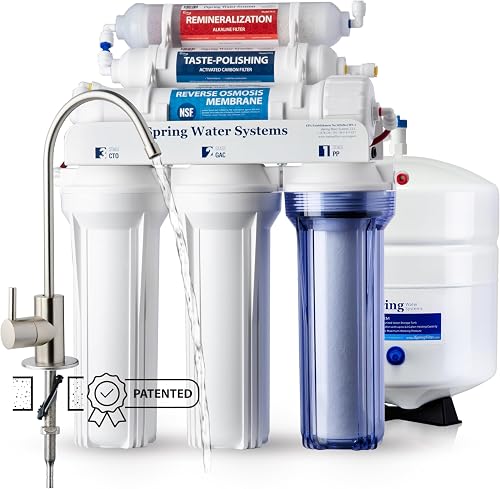
| System shape | One cartridge, no tank | Multi stage housings plus a storage tank in these models |
| Water waste | Very low, filters on demand | Drain water goes to the sink during filtration |
| Minerals | Keeps most minerals | Removes most, unless a remineralization stage adds some back |
| Upkeep | One cartridge change | Several pre filters plus an RO membrane over time |
| Space | Compact, fits tight cabinets | Larger, needs room for housings and a tank |
The four picks here split 3 to 1. Three are RO systems from iSpring, and one is a conventional Waterdrop filter.
That split reflects how many RO options asked for this comparison, not a claim that RO suits every home.
Read the table as a starting point, then match it to your water. For a pitcher option, see the Epic Pure Water Filter Pitcher review.
If your main complaint is chlorine taste, a conventional filter may be enough.
If you want dissolved solids and metals reduced, RO is the stronger tool.
How deep does each type of filtration go
RO goes deeper because water is pushed through a membrane, while a conventional filter uses carbon and similar media. The iSpring RCC7-BN filters down to 0.0001 microns, with 3 pre filters before the membrane.
The Waterdrop 10UA uses a carbon block filter and a PP folded element. Waterdrop says it reduces PFOA/PFOS, lead, chlorine, bad taste and odor.
It does not claim RO level removal of dissolved solids. It keeps essential minerals such as calcium, potassium, sodium and magnesium.
Choose RO for iSpring's stated reductions in PFAS, fluoride, lead, arsenic and TDS. Choose a conventional filter to keep minerals while fixing taste and chlorine.
Our best under sink water filter roundup compares conventional models in more detail.
What NSF certification does and does not tell you
Check the exact standard, since different standards cover different claims. The Waterdrop 10UA is NSF/ANSI 42 certified, which covers aesthetic effects such as chlorine taste and odor.
The three iSpring RO systems are NSF/ANSI 58 certified for RO systems and the contaminant reductions iSpring lists.
Do not treat a component claim as a full system claim. iSpring notes that its full systems meet NSF/ANSI 58, rather than only one part. Certification applies as tested under stated conditions, so results vary with source water.
Taste, minerals and TDS explained in plain terms
RO removes dissolved solids, while a conventional filter keeps your minerals. TDS is a rough measure of dissolved solids, not a full safety test.
iSpring says the RCC7-BN cuts TDS by 80 to 90 percent. The RCC7AK-BN lists 93 to 98 percent, and the RCC7AK-BLK lists 97.9 percent.
Those figures show how much RO changes the water.
Waterdrop keeps minerals on purpose, so TDS drops little with its system. A small TDS change alone does not mean its filter failed.
The two alkaline iSpring systems restore alkalinity and essential minerals in a final stage to lift flat RO taste. For tea and coffee, carbon cuts chlorine taste while RO cuts a wider range of dissolved substances.
The inline water filter guide covers another in line option.
Which taste suits daily drinking
Pick the flavor profile you will actually drink each day. Some buyers prefer RO water for its clean, low mineral taste.
Others prefer conventional filtered water because it still tastes like their tap water, minus chlorine.
If you drink a lot of water and enjoy its current mineral character, the Waterdrop 10UA is a natural fit. Its carbon is made from natural coconut shells, which Waterdrop notes for buyers with coconut allergy concerns.
If you want RO but worry about flat taste, the alkaline RCC7AK-BN and RCC7AK-BLK are the compromise.
Use a plain glass test at home when you compare. Serve both types cold, side by side, and judge the water you will choose on a normal day.
Water waste, tanks and drain lines
RO uses more water because the membrane needs a drain flow; a conventional filter does not. That adds water use and plumbing complexity.
The iSpring RO systems fill a storage tank, then send purified water to a separate faucet. For filtration at the refrigerator dispenser, compare Electrolux refrigerator water filters.
The Waterdrop 10UA has no tank and no drain line. Water passes through the cartridge on demand with low waste and simple plumbing.
Space follows the same pattern. The RCC7-BN measures 23.62 x 15.75 x 11.81 inches, the RCC7AK-BN measures 15.5 x 16 x 18 inches, and the Waterdrop 10UA measures only 3.9 x 3.6 x 12.3 inches and weighs 1.31 kg.
Measure your cabinet before you order an RO system. Check door swing, the garbage disposal, hot water lines and pull out drawers.
If space is tight, read our best under sink water filter tankless guide for a different layout.
Flow rate for filling glasses and pots
A conventional filter usually gives faster flow at the tap; RO flow depends on the tank and faucet. Waterdrop states a tested full flow rate of 0.75 gpm at 60 psi, with a 3/8 inch outlet rated at 1.33 GPM.
The RCC7-BN lists a maximum flow rate of 3.4 liters per minute.
The RCC7AK-BN lists 284 liters per day, which reflects the tank based RO design rather than instant tap flow. For filling a large pot, many buyers prefer instant flow.
For drinking water, an RO tank gives stored water on demand once full.
Space, installation and cabinet fit
Measure first, since RO systems need more room than a single cartridge filter. For a non-under-sink alternative, compare countertop water filters.
Every model here installs under the sink, but shapes differ a lot. For an RO setup on the counter, compare countertop reverse osmosis systems.
The Waterdrop 10UA fits tight spots and suits leased homes, RVs and offices. Its twist and lock design and push to connect fittings support a fast install, and it connects to 1/2 inch and 3/8 inch cold water pipes with a converter fitting.
The iSpring systems use push to connect fittings and color coded tubing. The RCC7-BN and RCC7AK-BN use a patented top mounted faucet design for tightening from above the counter.
Hot water lines are a common trap. The Waterdrop 10UA is for cold water only.
If you need filtered hot water, see our under sink water filter for hot water guide before you plan the install.
DIY install steps to plan for
Plan the drain line, faucet hole and cold water tee before you buy. RO installs take more steps because they add a tank, a drain saddle and a separate faucet.
Start with the cold water shutoff and feed water adapter. The RCC7AK-BN notes a convertible adapter for 1/2 inch NPT and 3/8 inch compression fittings.
Next, plan where the tank will sit, leaving room to open housings for filter changes.
Then plan the drain line with a proper air gap and secure saddle connection per the manual. A conventional filter skips tank and drain steps, so the job is shorter, but you still need a cold water tee and leak check.
Upkeep, filter changes and long term cost in time
Conventional upkeep is one cartridge; RO upkeep is pre filters, a membrane and a final filter. Your time, not just filter price, should shape this choice.
The Waterdrop 10UA has a 11000 gallon capacity and a 1 year filter life with municipal water. Its twist and lock cartridge is designed for a 3 second change, according to Waterdrop.
The iSpring RCC7-BN uses 3 pre filters before the membrane, a PP sediment filter, a GAC carbon filter and a carbon block filter. A fine GAC filter polishes water after the membrane.
The RCC7AK-BN lists replacement sets including F4AK for 6 months, F9K for 1 year, F19K75 for 2 years and F28K75 for 3 years. For exact steps, our best under sink water filter parts guide helps you match parts to models.
How to tell when a filter is due
Watch taste, flow and the first stage housing, in that order. If chlorine taste returns, the carbon stage is likely spent.
If flow slows, sediment or a clogged pre filter may be the cause.
Do not wait for a fixed date if your water is hard or high in sediment. Heavy sediment loads can shorten pre filter life.
The transparent housing on iSpring systems gives a direct view that a sealed cartridge does not.
Keep spares on hand for RO systems, since you may need more than one stage at the same time. A single cartridge filter is easier to stock, but it still needs a spare if you want no gap in filtration.
Which water source and home type suit each system
Municipal water with chlorine taste favors a conventional filter; water with dissolved solids favors RO. Well water changes the answer, since neither type here is a blanket fix for every well problem.
Waterdrop states that the 10UA is designed for municipal tap water. It is not suitable for well water or hot water.
If you are on a well, test the water first and choose a system built for your results.
The RCC7-BN lists a supported water TDS maximum of 750 ppm. High source TDS can make low output TDS harder to reach, as iSpring notes.
If your refrigerator has its own filter, do not assume an under sink system replaces it. Our Best Water Filter For Smart Refrigerators guide explains how fridge filters and under sink systems can overlap or complement each other.
Who should buy RO in this group
Buy RO if you want the widest reduction and you have space for a tank. The 3 iSpring systems here are the RO route, and they differ mainly in stages and faucet finish.
The RCC7-BN is the 5 stage option with a brushed nickel faucet for buyers who want RO without the alkaline stage. The RCC7AK-BN is the 6 stage alkaline option in brushed nickel.
The RCC7AK-BLK is the 6 stage alkaline option with a black faucet.
Who should buy a conventional filter in this group
Buy the Waterdrop 10UA if taste and chlorine are your main goals. It is the only conventional filter in this group, and it is built for simple, compact use.
It suits kitchens with limited cabinet space, leased homes, RVs and small offices. It also suits buyers who want to keep minerals in their water.
Skip it if you need RO level reduction of dissolved solids or fluoride.
Safety, cold water limits and care tips
Use cold water only where the maker requires it, and check seals after each change. Heat can damage media and seals, and pressure leaks can cause water damage fast.
Waterdrop states that the 10UA must use a cold water source only. The iSpring RO systems also list a lower temperature range of 40 F, so keep them from freezing.
After any filter change, run water through the system per the manual, then check every push to connect fitting for leaks before you close the cabinet. Do not use a conventional filter on hot water to solve a hot water need.
Our How Often Should You Replace a Refrigerator Water Filter? post covers replacement timing for fridge filters. Keep the area under the sink dry and visible, and wipe up small leaks promptly.
Under sink water filter vs reverse osmosis final verdict
Pick RO for broader contaminant reduction and pick a conventional filter for simple taste improvement with less waste. That rule fits every system in this comparison.
Choose the iSpring RCC7-BN for 5 stage RO with a brushed nickel faucet. Choose the iSpring RCC7AK-BN for 6 stage alkaline RO in brushed nickel, or the iSpring RCC7AK-BLK for the same alkaline stage with a black faucet.
Choose the Waterdrop 10UA for a compact, tank free filter for municipal cold water, chlorine taste and odor. It keeps minerals, gives fast flow and needs only one cartridge change.
Before you order, test your water, measure your cabinet and confirm cold water only use. Then match the system to the contaminants you care about most.
Frequently asked questions
Is reverse osmosis better than an under sink water filter?
Reverse osmosis is better when you want wider contaminant reduction, including dissolved solids, PFAS and lead at the levels iSpring states for its systems. A conventional under sink filter is better when your main goals are chlorine, taste and odor removal with less waste and simpler upkeep.
Does reverse osmosis remove minerals from water?
Yes, RO removes a large share of dissolved solids, which is why RO water can taste flat. The two alkaline iSpring systems in this comparison add minerals back in a final stage, while a conventional filter such as the Waterdrop 10UA keeps most minerals in the water.
Which system wastes more water?
Reverse osmosis systems send drain water to the sink drain as part of how the membrane works, so they use more water than a conventional under sink filter. A conventional filter filters water on demand and does not need a storage tank or a drain line.
Can an under sink filter work for hot water?
Most under sink systems, including the Waterdrop 10UA here, are for cold water only. If you need filtered hot water, check the limits for any model before you buy, and look for a system made for that use rather than forcing a cold water filter onto a hot line.
How often do you change these filters?
It depends on the model and your water use. The Waterdrop 10UA has a 11000 gallon capacity and a 1 year filter life, while the iSpring RO systems use multi stage pre filters and an RO membrane.
Follow the schedule for your exact model and watch for taste or flow changes.