7 Best Refrigerator Surge Protectors (October 2026)
The best refrigerator surge protectors include the Refrigmatic 2 in 1 Voltage & Surge for compact kitchens, the BSEED Surge Protector Home Appliance for clear indicators, and the Ortis Refrigerator Surge Protector for dual appliances.
On this page (8 sections)
- The best refrigerator surge protectors by setup
- How we compared refrigerator surge protectors
- How should you choose a refrigerator surge protector?
- How do you set up and care for a refrigerator surge protector?
- What mistakes should you avoid when using a refrigerator protector?
- Which outlet setup and restart delay fit your refrigerator?
- Do you need a refrigerator surge protector for a smart fridge?
- Which refrigerator surge protector should you choose?
The best refrigerator surge protector for most single-fridge setups is the Refrigmatic 2 in 1 Voltage & Surge. It pairs high and low voltage cutoffs with a 3-minute delay and an angled outlet.
A refrigerator protector should match your appliance’s electrical limits, outlet layout and preferred restart delay. For two appliances, consider Ortis; for a large refrigerator, compare the Refrigmatic Mega.
If you're checking the outlet first, read Refrigerator Voltage Requirements: Safety Guide. For a smart model, our guide to plugging a smart refrigerator into a regular outlet covers the outlet question.
Our picks at a glance
-
1

-
2
-
3

- 4
 Check it
Nippon Power 1875 Watts Refrigerator Voltage Protector
Best for longer delays - 5
 Check it
Refrigmatic Mega Voltage & Surge Protector
Best for large fridges - 6
 Best for multiroom homesCheck it
- 7
 Check it
Fosmon Refrigerator Surge Protector
Best for 15 amp circuits
The best refrigerator surge protectors by setup
The Refrigmatic 2 in 1 is the best refrigerator surge protector here for a typical single-fridge setup. The other picks are aimed at buyers who need two outlets, a larger appliance fit, a longer restart interval or several units for separate locations.
Refrigmatic 2 in 1 Voltage & Surge: Best for compact kitchens
- 303-joule surge capacity
- Cuts off power above 140 VAC or below 90 VAC
- 3-minute delay
- Angled single outlet
This single-outlet protector combines high and low voltage cutoffs with a 3-minute delay. The angled outlet can help a refrigerator sit closer to the wall.
Pros
- 303-joule surge capacity
- Indicators for voltage status and delay
- Angled outlet
Cons
- One outlet
- Recommended for refrigerators up to 27 cu. ft.
The Refrigmatic 2 in 1 combines 303 joules of surge capacity with automatic cutoffs above 140 VAC and below 90 VAC. Its lights indicate normal, high or low voltage, along with delay time.
A 3-minute wait applies at first use, and the delay indicator comes on after a high-voltage event. The protector is recommended for domestic refrigerators up to 27 cu. ft., plus ice makers and air conditioners up to 5000 BTU.
Its angled outlet helps keep the plug profile compact behind a refrigerator. Choose this model if you need one outlet and want voltage status and delay shown by separate lights.
Skip it if your refrigerator is larger than the stated size recommendation or if you need to connect a second appliance through the same device. Check the refrigerator’s manual and electrical requirements before buying.
BSEED Surge Protector Home Appliance: Best for clear indicators
- 1050-joule surge rating
- 3-minute delay
- Four LED status indicators
- Single outlet
Four indicators show normal, high, low and delay states. Its single outlet suits one appliance, and BSEED specifies a 3-year warranty.
Pros
- 1050-joule surge rating
- Four status indicators
- 3-minute delay
Cons
- One outlet
- Maximum current is 10 A
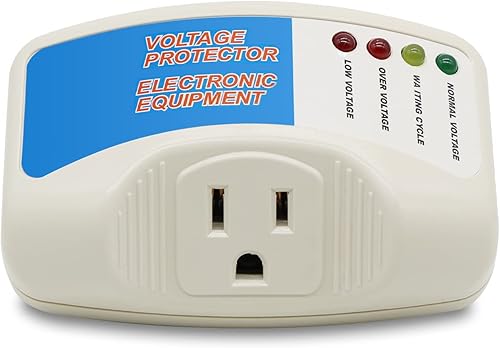
BSEED’s single-outlet protector has a 1050-joule surge rating and a 3-minute delay after voltage fluctuations. Four LED indicators show normal output, high voltage, low voltage and delay.
Its maximum current is 10 A, so compare that limit with your refrigerator’s requirements before buying. BSEED specifies a 3-year warranty, which may matter if you want stated coverage alongside the electrical features.
Choose it when a clear status display and a higher stated joule figure are priorities. It has one outlet, so it does not serve a second appliance at the same socket.
Skip it if your appliance’s current needs exceed 10 A or if you want more than one outlet on the protector. Its current limit matters more than the compact appearance when checking whether it fits your refrigerator.
Ortis Refrigerator Surge Protector: Best for dual appliances
- Two outlets
- 3-minute delay
- High and low voltage indicators
- Maximum current of 20 A
Ortis has two outlets and indicators for normal, high, low and delay states. Check that the combined appliances stay within the protector's stated limits.
Pros
- Two outlets
- 3-minute delay
- Indicators show voltage status
Cons
- Joule rating is not specified
- Confirm the second appliance is suitable
Ortis is the pick for a setup that needs two outlets. It has indicators for normal, high, low and delay states, and automatically cuts power when voltage falls below or rises above its limits.
After voltage returns to normal, Ortis uses a 3-minute delay before reconnecting. Its maximum current is 20 A, but a joule rating is not specified, so compare its outlet count and delay with the details you need.
The second outlet may suit another compatible appliance, but confirm that both devices and their combined electrical draw fit your setup. Choose a single-outlet protector if the refrigerator should be the only connected appliance.
Skip Ortis if you specifically need a published joule rating to compare surge capacity. Its extra outlet is useful only when the second appliance is compatible and both devices stay within the protector’s limits.
Nippon Power 1875 Watts Refrigerator Voltage Protector: Best for longer delays
- 4-minute safety cycle
- Up to 1800 W appliance capacity
- AC 85–135 V safety range
- Auto-sensing 50/60 Hz
Nippon Power is designed for domestic refrigerators and similar appliances, with a 4-minute safety cycle. Its surge function can be spent after a sufficiently large surge.
Pros
- 4-minute safety cycle
- Up to 1800 W capacity
- Auto-senses 50/60 Hz
Cons
- Surge function may be single-use after a sufficient surge
- No joule rating specified
Nippon Power stands out for its 4-minute safety cycle, one minute longer than the 3-minute delays common among the other picks. It’s designed for domestic refrigerators, freezers and water coolers, and can handle appliances up to 1800 W.
The stated operating safety range is AC 85–135 V, and the device auto-senses 50/60 Hz. Its surge function works like a fuse: after a sufficiently large surge, the protector may be spent and need replacement.
Choose Nippon Power if its wattage and voltage range fit your appliance and you prefer the longer restart cycle. Check the refrigerator’s electrical requirements before relying on the 1800 W capacity.
Skip it if you want a joule rating for side-by-side comparison or a device with a clearly described continuing surge-protection function. After a sufficiently large surge, it may no longer protect the appliance.
Refrigmatic Mega Voltage & Surge Protector: Best for large fridges
- For refrigerators 27 cu. ft. or larger
- 1005-joule rating
- 3-minute initial delay
- Quick restart button
The Mega is intended for large refrigerators and freezers, including models 27 cu. ft. or larger. It has a quick restart button and a delay indicator.
Pros
- 1005-joule rating
- For large refrigerators
- Quick restart button
Cons
- One outlet
- Restart button can bypass the 3-minute delay
Refrigmatic Mega is intended for large refrigerators 27 cu. ft. or larger and large freezers. Its 1005-joule rating, high and low voltage cutoffs, and delay indicator address buyers who need a protector designed for a bigger appliance.
At first use or after a power outage, it starts with a 3-minute delay. After a high-voltage event, it cuts power for 30 seconds, and its quick restart button can restore power before the 3-minute delay ends.
That button gives you control, but restarting early skips the full waiting interval. Choose Mega for a large refrigerator if its single outlet and restart behavior fit how you plan to use it.
Skip it for a smaller refrigerator if a compact single-fridge model better matches your setup, or if you do not want a manual button that can bypass the initial wait. Use the button only when you understand that it ends the delay early.
BSEED Voltage Protector: Best for multiroom homes
- Four single-outlet protectors per pack
- 3-minute delay
- Four LED indicators
- 15 A maximum current
This four-pack provides one outlet per protector, so units can serve separate appliance locations. Each has indicators for normal voltage, overvoltage, low voltage and the waiting cycle.
Pros
- Four protectors in a pack
- 3-minute delay
- Four status indicators
Cons
- One outlet per unit
- Joule rating is not specified
This BSEED model comes as a four-pack of single-outlet protectors, each with four indicators for normal voltage, overvoltage, low voltage and waiting cycle. A 3-minute delay is intended to prevent rapid power cycling during repeated voltage changes.
The 15 A maximum current and 120 V specification are useful comparison points. The joule rating is not specified, so choose it for its pack size and indicator features rather than a stated surge-capacity number.
The four units may help if you want protection at separate appliance locations. Each protector has one outlet, so this is not a way to connect several appliances at one socket.
Skip the pack if you only need one protector and would rather compare a specified joule rating. It is useful when several separate outlets need individual devices, not when one location needs multiple outlets.
Fosmon Refrigerator Surge Protector: Best for 15 amp circuits
- 140-joule rating
- 3-minute restart delay
- Four LED status indicators
- 15 A maximum current
Fosmon pairs a 3-minute restart delay with four status lights. Its 140-joule rating is lower than several other picks here, so compare that figure with your priorities.
Pros
- Four status indicators
- 3-minute restart delay
- 15 A maximum current
Cons
- 140-joule rating
- One outlet
Fosmon offers four status lights for normal, high voltage, low voltage and delay modes. It has a 140-joule rating, 15 A maximum current and a 3-minute restart delay after an out-of-range voltage event.
The stated appliance limit is 120 VAC, 15 A and a maximum 1/3 HP motor load. Check your refrigerator’s requirements against those limits, especially if you’re choosing this for a large appliance.
Choose Fosmon when the status lights and restart interval matter more than a higher joule figure. It has one outlet and is intended to protect one appliance.
Skip it if your priority is the highest stated joule rating among these picks. At 140 joules, its rating is lower than several other models listed here, so decide whether the indicators and delay make up for that tradeoff in your situation.
How we compared refrigerator surge protectors
We compared the stated surge ratings, voltage cutoffs, restart delays, outlet counts and appliance limits for each pick. A higher joule rating gives one comparison point, but the voltage range and current limit still need to fit your refrigerator.
Our scores weigh specs, features and buyer feedback against the needs of someone shopping for refrigerator protection. The product fit recommendations use the available product details.
| Product | Best for | Surge rating | Delay | Outlets | Our score |
|---|---|---|---|---|---|
| Refrigmatic 2 in 1 Voltage & Surge | compact kitchens | 303 joules | 3 minutes | 1 angled outlet | 9.7 |
| BSEED Surge Protector Home Appliance | clear indicators | 1050 joules | 3 minutes | 1 | 9.6 |
| Ortis Refrigerator Surge Protector | dual appliances | Not specified | 3 minutes | 2 | 9.5 |
| Nippon Power 1875 Watts Refrigerator Voltage Protector | longer delays | 4-minute safety cycle | 1 | 9.4 | |
| Refrigmatic Mega Voltage & Surge Protector | large fridges | 1005 joules | 3 minutes initially | 1 | 9.3 |
| BSEED Voltage Protector | multiroom homes | Not specified | 3 minutes | 1 per protector | 8.8 |
| Fosmon Refrigerator Surge Protector | 15 amp circuits | 140 joules | 3 minutes | 1 | 8.5 |
How should you choose a refrigerator surge protector?
Choose a refrigerator surge protector by matching its electrical limits and features to the refrigerator manual, then deciding whether you need one outlet, a delay display or a particular restart interval. Don't select by joule rating alone.
What should you check before buying the best refrigerator surge protector?
Start with the refrigerator’s voltage, current or wattage requirements. Compare those with the protector’s stated limits, such as BSEED’s 10 A maximum, Fosmon’s 15 A limit, Ortis’s 20 A maximum or Nippon Power’s 1800 W capacity.
Next, check the intended refrigerator size and the plug arrangement. The standard Refrigmatic is recommended for refrigerators up to 27 cu. ft., while Refrigmatic Mega is intended for refrigerators 27 cu. ft. or larger.
Finally, measure the outlet area. An angled plug may help when a refrigerator sits close to the wall, but leave enough room to reach the status lights and remove the device when needed.
How much surge protection does a refrigerator need?
A joule rating is one way to compare protectors, but it is not the only relevant detail. Refrigmatic 2 in 1 specifies 303 joules, Refrigmatic Mega 1005 joules and Fosmon 140 joules; several others do not specify a rating here.
Look at voltage cutoffs, current or wattage capacity, and delay behavior as well. If you’re comparing models specifically by restart interval, see our roundup of refrigerator surge protectors with delay.
Is a voltage protector the same as a surge protector?
Some refrigerator protectors combine both jobs. The Refrigmatic, BSEED and Ortis options listed here describe protection against high and low voltage events as well as spikes or surges.
Check each model’s stated features rather than relying on its name alone. A voltage cutoff range can matter in areas where voltage drops or brownouts happen.
Should a refrigerator protector have a delay?
A delay can keep power from returning immediately after a voltage fluctuation. Several picks here specify a 3-minute delay or waiting cycle; Nippon Power uses a 4-minute safety cycle.
The Refrigmatic Mega has a quick restart button that can restore power before its initial 3-minute delay ends. Consider whether you want a manual override, and read the instructions before using it.
How do you set up and care for a refrigerator surge protector?
Set up a refrigerator protector by plugging it into a suitable wall outlet, checking the status lights and following the startup delay before connecting the appliance. The Refrigmatic 2 in 1 specifically requires a 3-minute wait before you plug in the refrigerator the first time.
Read the protector’s instructions before installation. Confirm that the wall outlet, voltage and appliance limits match the refrigerator and protector, and avoid using the device if its lights show an out-of-range condition.
Keep the indicators visible enough to check the normal, high, low or delay state. Do not block access to the plug, and inspect the protector periodically for signs of damage, looseness or heat; replace it if it appears damaged.
After an outage or voltage event, allow the protector’s full delay to finish unless its instructions say otherwise. Refrigmatic Mega’s quick restart button can bypass the initial wait, so pressing it means choosing to resume power before that interval ends.
What mistakes should you avoid when using a refrigerator protector?
The most common mistake is choosing a device without checking the refrigerator’s electrical requirements. A protector’s outlet count or joule rating does not make it suitable if its current, voltage or wattage limit is wrong for the appliance.
Avoid plugging multiple appliances into a protector simply because it has a spare outlet. Ortis has two outlets, but both appliances and their combined draw must fit its limits.
Do not mistake a delay indicator for a fault without checking the instructions. It may show that the unit has cut power temporarily while voltage stabilizes.
Do not assume every protector has the same delay or surge rating. Compare the specific model, and remember that Nippon Power may be spent after a sufficiently large surge.
Which outlet setup and restart delay fit your refrigerator?
Choose an outlet configuration that matches the number of appliances you intend to protect, and confirm the electrical limits before plugging anything in. Most options here have one outlet; Ortis has two, while the BSEED four-pack contains four separate single-outlet units.
An angled plug can help with clearance behind a refrigerator, as on the Refrigmatic 2 in 1. Measure the space between the outlet and refrigerator before you choose a device, and leave room to reach its indicators.
Restart intervals also vary. A 3-minute delay is common in this group, Nippon Power uses 4 minutes, and Refrigmatic Mega’s quick restart button can bypass its initial delay.
For a broader explanation of voltage events and protection choices, read Fridge Power Surge Protection: Protect Your Smart Tech. If you’re changing the appliance setup, our guide to using a smart fridge to reduce single-use plastic covers another way to get more from a connected refrigerator.
Do you need a refrigerator surge protector for a smart fridge?
A smart refrigerator still needs an outlet and electrical setup that match its maker’s requirements. A surge protector may add voltage cutoffs or a restart delay, but confirm compatibility before connecting a smart appliance through one.
The right choice depends on the refrigerator’s instructions and the protector’s limits. If the fridge has a water line or you’re troubleshooting another issue, our guide to why a smart refrigerator may be leaking water covers common checks.
Which refrigerator surge protector should you choose?
Choose the Refrigmatic 2 in 1 for one refrigerator and a compact angled outlet, or Ortis when you need two outlets and its limits fit both appliances. For a refrigerator 27 cu. ft. or larger, consider Refrigmatic Mega; choose Nippon Power if its capacity and 4-minute cycle match your requirements.
Before ordering, match the protector’s electrical limits to your refrigerator manual and decide whether a second outlet or longer delay matters. For smart models, review how to plug a smart refrigerator into a regular outlet alongside the appliance maker’s instructions.
Our top 3 picks at a glance
-
1
-
2
-
3
Frequently asked questions
Does a refrigerator need a surge protector?
A refrigerator surge protector can cut power during high or low voltage events and may delay restart after power returns. Those features can help reduce repeated on-off cycling during unstable power.
Check the refrigerator manual and your home’s electrical setup before adding a device.
Is a power strip safe for a refrigerator?
Use the refrigerator maker’s guidance for outlet and power-strip requirements. Many appliance protectors in this guide use a single wall outlet and are made for large appliances.
A standard multi-outlet strip may not provide voltage cutoffs or a compressor restart delay.
What joule rating should a refrigerator surge protector have?
Compare joule ratings when they’re given, but don’t use that number alone to choose a refrigerator protector. Cutoff voltage, restart delay, current capacity and outlet layout also affect fit.
Several products here do not specify a joule rating, so compare their other stated features.
Why does a refrigerator surge protector have a delay?
A delay gives voltage time to stabilize before power returns to the refrigerator. Several picks here use a 3-minute delay, while Nippon Power specifies a 4-minute safety cycle.
Follow the protector’s instructions and avoid bypassing a delay unless you understand the tradeoff.
Can one protector power a refrigerator and another appliance?
Only if the protector has enough outlets and its electrical limits suit both appliances. Ortis has two outlets, while most picks here have one.
Check both appliance requirements and the protector’s current or wattage limits before sharing an outlet.