How to Choose an Under Sink Filter for Hot and Cold Water
Most under sink filters are cold water only, so choose one rated for your exact use: pick a cold-only carbon filter for drinking and cooking, a rated hot water model only if the maker allows hot feed, and add a chiller or cooler separately for cold servings. Check temperature limits, pressure and fittings before you buy.
On this page (11 sections)
- How does an under sink water filter hot and cold setup work in practice?
- What temperature ratings should you check before you buy?
- How do carbon filters differ from reverse osmosis for temperature use?
- Can you use an under sink water filter for hot water at all?
- How does chiller and cooler compatibility change your choice?
- How do you size an under sink filter for space, flow and capacity?
- How do fittings and installation affect hot and cold use?
- How do you maintain filters, tanks and chillers for safe daily use?
- How should you compare the three systems for hot and cold needs?
- What mistakes should you avoid with under sink filter hot and cold plans?
- Which under sink filter hot and cold setup should you buy?
Most under sink filters are cold water only, so hot and cold use needs a rated filter plus a separate chill step. If you are filtering a refrigerator dispenser, compare inline refrigerator water filters.
A cold only filter can serve a chiller or cooler after filtration, but it should not take hot feed unless the maker states a hot temperature rating.
Start with your water test and your faucet layout. You need to know if you want filtered hot water at the tap, or filtered cold water for drinking while the main faucet still gives hot water for dishes and hands.
That split matters for safety and taste. Heat can shorten filter life, warp seals and change how carbon and membranes work.
Cold filtered water chilled later is the safer path for most homes.
We compared the specs, fittings and temperature notes for three systems below. Each one helps a different buyer, and none should be assumed hot rated without a maker statement.
How does an under sink water filter hot and cold setup work in practice?
A hot and cold setup works when filtration stays on cold water and chilling happens after filtration. The filter removes chlorine, taste and other targets first, then a chiller or cooler lowers the filtered water for drinking.
You keep the main faucet for hot water. For another drinking-water option, see this guide to a stainless steel water filter pitcher.
A separate filtered faucet, or a filtered line to a chiller, gives you cold drinking water without sending heat through the filter.
This layout protects the filter media. Carbon blocks and reverse osmosis membranes both work best within the maker temperature range.
Exceeding that range can damage parts or void support.
It also keeps flow steady. Chillers add storage and tubing after the filter, so you should check flow rate and pressure before pairing them.
Our score weighs specs, features and buyer feedback against what you are shopping for. Hot water use weighs temperature ratings more than raw capacity.
If you want the broader buying context first, our inline water filter guide explains where inline units fit beside under sink models.
What temperature ratings should you check before you buy?
Check the maximum feed temperature for every part water touches, not just the filter cartridge. That includes the housing, faucet, tubing, seals and any chiller line.
Many makers state a low limit and no high limit for hot use. A low limit of 35 F or 40 F protects against freezing.
It does not prove the unit can take hot water.
Look for a clear hot rating in degrees, plus notes on hot pressure and hot filter life. If that rating is missing, treat the system as cold only.
Also check pressure. Heat and pressure together stress fittings.
A rating that allows warm water may still bar hot water at full pressure.
What counts as hot water for a filter maker?
Makers may treat warm, hot and scalding water as different bands. Some allow warm feed for washing, while hot feed from a water heater is barred.
Ask in exact terms. State the water heater set point and the likely temperature at the filter inlet.
Do not guess from the word hot in a product name. Some names refer to hot serving after a chiller, not hot feed into the filter.
The rule is firm: no stated maximum temperature means no hot feed.
How do carbon filters differ from reverse osmosis for temperature use?
Carbon filters and reverse osmosis systems differ in method, flow and temperature tolerance. Neither method is automatically hot rated, so the maker rating still controls.
Carbon blocks trap chlorine, taste and odor, plus lead and other targets when certified for them. They keep minerals that carbon does not remove, and flow is usually faster.
Reverse osmosis pushes water through a membrane and can reduce dissolved solids. It often adds a storage tank, a dedicated faucet and more tubing under the sink.
For hot and cold use, carbon is often simpler. It is compact, runs on line pressure and pairs well with a downstream chiller.
Reverse osmosis needs more space and check valve care.
Our under sink water filter vs reverse osmosis guide compares the methods in depth.
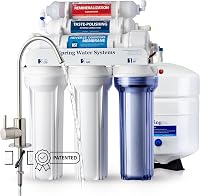
The iSpring RCC7AK-BN is a 6-stage reverse osmosis system with a 75 GPD rating. iSpring says it is NSF/ANSI 58 certified as a full system and lists reductions for TDS, PFAS, chlorine, lead and many other contaminants.
Its top mounted faucet design fits countertop installation from above. That helps when the nut under the sink is hard to reach.
It also includes a brushed nickel faucet, storage tank and extra tool set. The system runs without electricity, which suits kitchens without a spare outlet.
For hot and cold use, keep this on cold feed and chill after the tank if you want cold servings. If you want filtration at the refrigerator dispenser, compare LG LT800P refrigerator filters.
Do not feed hot water into the membrane or housing.
Pick reverse osmosis when dissolved solids matter most. Pick carbon when you want faster flow and a smaller footprint.
Can you use an under sink water filter for hot water at all?
Yes, but only with a model the maker rates for hot feed. Most standard under sink filters do not meet that test.
Check the full system, not one cartridge. A hot rated cartridge inside a cold rated housing is still a cold only system.
Hot water can also change taste results. Carbon may exhaust faster, and membranes and seals face more stress.
Filter life claims for cold water may not carry over.
If hot filtration is your main goal, search for that exact rating first. Then filter out every model that only lists a low temperature limit.
Our under sink water filter for hot water page covers the ratings to hunt for and the risks to avoid.
You can also keep a cold filter for drinking and use the main faucet for hot water. That split is safe for most homes and avoids a costly hot rated search.
The rule is firm: hot feed needs a hot rating on the whole system.
How does chiller and cooler compatibility change your choice?
Chiller compatibility means the filter can feed a chiller or cooler on the filtered side. It does not mean the filter can take hot water.
Place the chiller after the filter. That way, chlorine and taste are handled before water sits in a chiller tank or lines.
Check flow in gallons per minute and pressure in psi. A chiller needs steady feed, and a slow filter can starve it or cause short cycling.
Check tank size and tubing length too. Long runs add pressure loss and places for stagnation.
Short, clean runs are easier to keep fresh.
Also check power and space. A chiller needs an outlet and ventilation, while a filter needs room for changes and a drip tray path.
What should you ask the chiller maker?
Ask about inlet pressure, flow, minimum and maximum feed temperature and approved tubing size. Those answers set the filter you can pair with it.
Ask whether the chiller expects filtered water or can accept unfiltered water. Most homes filter first for taste and safety.
Ask about cleaning intervals for the chiller tank. A filter does not remove the need to clean downstream parts.
The rule is firm: filter on cold water first, then chill the filtered water.
How do you size an under sink filter for space, flow and capacity?
Size the system for the tightest cabinet, not the open floor. Measure width, height, depth and door swing before you order.
Compact carbon units often fit beside pipes and cleaning bottles. Larger reverse osmosis systems need tank space plus room to turn housings and change cartridges.
Flow matters for daily use. A system rated at 0.75 gpm at 60 psi will feel slower than one rated higher at the same pressure.
Test your home pressure if flow is a concern.
Capacity matters for cost and effort. High gallon ratings can mean long service, but only at the maker test conditions.
Your water quality and use can change real life.
The Waterdrop 10UA is NSF/ANSI 42 certified and rated for 1 year or 11,000 gallons in the specs. Waterdrop says it is for municipal tap water and cold water only, not well water or hot water.
It uses twist and lock fittings and push to connect lines. Waterdrop says install can take about 3 minutes and replacement about 3 seconds.
The unit measures 3.9 in by 3.6 in by 12.3 in. That compact shape suits renters, RVs and small cabinets where a tank will not fit.
It reduces PFOA/PFOS, lead, chlorine and bad taste and odor in the maker claims. It keeps essential minerals, so TDS may not drop in the way some buyers expect.
Pick this for simple cold filtration with fast changes. Skip it for hot feed, well water or TDS reduction.
How do fittings and installation affect hot and cold use?
Fittings decide whether a good filter fits your sink at all. Check thread size, line size and cold line access before you compare features.
Many US sinks use 3/8 in feed lines with 1/2 in or 3/8 in cold pipes. Adapters can bridge that gap, but each adapter adds a joint that can leak.
Push to connect fittings speed install and repair. They also need clean, square cuts and full insertion to seal well.
A top mounted faucet can save time when under sink access is poor. A freestanding unit can save drilling when you rent or move.
Our best under sink water filter roundup compares models by fit and features for cold filtration.
Measure the cold line first. Confirm the valve thread, the line size and the space around the shutoff valve.
Also plan for a leak check. Keep paper towels on hand, open the valve slowly and watch every joint before you close the cabinet.
The rule is firm: match the fittings to your sink before you shop for features.
How do you maintain filters, tanks and chillers for safe daily use?
Replace cartridges on schedule, not on taste alone. Chlorine taste can return late, while lead or PFAS reduction can fade before taste changes.
Note the install date on the housing or in a phone note. Set a reminder for 6 months or 12 months, based on the maker rating for your model.
Flush new cartridges as the maker directs. That step clears carbon dust and helps flow start clean.
Clean tanks, lines and chiller parts on each maker schedule. Stagnant water in a tank or cooler can grow taste and odor even when the filter is fresh.
The Waterdrop UL12A is an upgraded 10UA style unit with a time reminder. Waterdrop says the indicator turns red and the unit beeps when it is time to replace the filter.
It is freestanding with a suction cup base and needs no drilling. That design suits renters and RVs where mounting hardware is a problem.
Waterdrop says it reduces PFOA/PFOS, rust, lead, chlorine, heavy metals and chemical impurities, and improves taste and odor. It does not reduce TDS.
It meets NSF/ANSI 42 and 372 standards in the maker claims. The specs list a 1 year life, capacity up to 18,750 gallons in one claim and 11,000 gallons in another, so use the cartridge rating for your exact filter.
It is for cold water sources. Keep hot water out of the unit and chill filtered water downstream if you want cold servings.
Pick this for no drill cold filtration with a clear change signal. Skip it if you need TDS reduction or hot feed.
How should you compare the three systems for hot and cold needs?
Compare by temperature first, then by method, space and flow. All three systems here are best used on cold water.
The iSpring RCC7AK-BN suits buyers who want reverse osmosis and alkaline remineralization. It needs more space for the tank and faucet, but it targets dissolved solids.
The Waterdrop 10UA suits buyers who want compact carbon filtration with a 1 year cartridge. It is cold only and keeps minerals.
The Waterdrop UL12A suits renters who want no drill setup and a reminder. It is also cold only and does not reduce TDS.
Check the parts you will need next. Our best under sink water filter parts guide helps you match cartridges and adapters.
Also check fridge lines if you plan to feed a refrigerator. Our best water filter for smart refrigerators page shows where fridge filters fit beside under sink units.
Ask one question for each model: can it take my feed temperature, fit my cabinet and meet my flow need. If any answer is no, move on.
The rule is firm: temperature rating beats capacity and feature lists.
What mistakes should you avoid with under sink filter hot and cold plans?
Avoid feeding hot water into a cold only filter. That is the top mistake and it can damage seals, media and membranes.
Avoid assuming a chiller makes a filter hot rated. A chiller cools filtered water after filtration.
It does not protect a filter from hot feed.
Avoid ignoring pressure. Low pressure can starve a chiller or reverse osmosis system.
High pressure can stress joints and housings.
Avoid skipping the water test. Municipal water, well water and private supplies need different targets.
The Waterdrop 10UA, for example, is for municipal tap water only.
Avoid storing a used filter in a freezer. Waterdrop says to store filters in sealed bags in a refrigerator, not the freezer, when you store them before a trip.
Our how often should you replace a refrigerator water filter guide also helps you set a change routine for fridge lines.
Plan the cold line, the filter, the chiller and the faucet as one system. You will save time and avoid leaks.
The rule is firm: keep heat out of cold rated parts.
Which under sink filter hot and cold setup should you buy?
Buy the setup that matches your feed temperature and your water test. For most homes, that means a cold only filter plus a chiller for cold servings.
Pick the iSpring RCC7AK-BN if you want reverse osmosis, alkaline remineralization and a top mounted faucet. Keep it on cold feed and plan for tank space.
Pick the Waterdrop 10UA if you want a compact carbon filter for municipal cold water. It suits drinking, cooking and small spaces with fast changes.
Pick the Waterdrop UL12A if you rent or want no drill setup with a reminder. It suits cold water only and does not reduce TDS.
For hot water at the tap, buy only a system with a stated hot rating for the whole system. If you cannot find that rating, keep hot water on the main faucet.
Start with our best under sink water filters roundup to compare cold models by space and flow. Then add a chiller that matches the filter flow and pressure.
The final rule is firm: filter cold water, chill after filtration, and never guess a hot rating.
Frequently asked questions
Can an under sink water filter handle hot and cold water at the same time?
Only if the maker rates the filter, housing and lines for hot feed. Most carbon and reverse osmosis systems here are cold only.
Hot water can damage media and seals, so use a hot rated model or keep filtration on the cold line.
Can I add a chiller to a cold only filter?
Yes, when the filter makers allow a downstream chiller or cooler. Filter first on cold water, then chill the filtered water.
Keep the chiller on the filtered side and check flow, pressure and tank size before fitting.
What temperature limit should I check first?
Check the lowest and highest feed temperature for the filter, housing, faucet and tubing. The models below list low limits of 35 F or 40 F.
A low limit does not mean hot water is allowed.
You need a stated maximum hot rating.
Do I need reverse osmosis for hot and cold use?
No, reverse osmosis suits dissolved solids and broad contaminant reduction, but it is usually cold only and slower. A carbon filter suits taste, chlorine and lead reduction with faster flow.
Match the method to your water test, not to temperature alone.